Cardano Founder: Bitcoin’s Quantum Fix Is a Hard Fork That Can’t Save Satoshi’s Coins


Charles Hoskinson, the founder of the Cardano blockchain network, stated this week that addressing Bitcoin’s vulnerability to quantum computing will necessitate a network hard fork. The proposed upgrade path requires a fundamental divergence from the current protocol consensus. According to Hoskinson, this structural change presents a severe limitation regarding early network assets.
Specifically, Hoskinson indicated the required “quantum fix” cannot secure the original coins mined by Bitcoin’s pseudonymous creator, Satoshi Nakamoto. A hard fork implementation forces active network participants to adopt new software rules to protect their private keys. However, it cannot retroactively alter the cryptographic parameters of unmoved funds without the owner actively initiating a transaction.
Because the Nakamoto addresses have remained inactive since the network’s inception, those assets cannot automatically migrate to a new, quantum-resistant address format. The necessity of a hard fork underscores the technical rigidity of the Bitcoin base layer when confronted with advanced decryption threats.
The inability to secure these specific early coins creates a permanent vulnerability for the network’s oldest holdings. While active users may transition their funds to the upgraded fork, the Nakamoto supply will remain entirely reliant on legacy cryptography.
BIP-361 and the Zero-Knowledge Recovery Dispute
The current technical debate centers on Bitcoin Improvement Proposal 361 (BIP-361). Authored by developer Jameson Lopp and others, the proposal aims to phase out quantum-vulnerable addresses and freeze dormant funds to prevent future theft. Proponents classify the update as a soft fork.
Hoskinson disputes this classification. He stated that because BIP-361 invalidates existing signature schemes relied upon by users, it functionally operates as a hard fork. He argues that labeling it a soft fork obscures the fundamental protocol changes required.
The proposal includes a zero-knowledge recovery mechanism tied to BIP-39 seed phrases, allowing active users to reclaim frozen funds. However, the BIP-39 standard was not introduced until 2013. Consequently, approximately 1.7 million early Bitcoin, including the estimated 1.1 million mined by Nakamoto, lack the necessary cryptographic structure for this recovery method.
Without a seed phrase to generate a zero-knowledge proof, these early assets would remain permanently frozen under the current proposal draft. The protocol cannot verify ownership for migration without the required cryptographic input.
Governance and Network Consensus
The dispute over BIP-361 extends into protocol governance mechanics. Hoskinson cited the controversy as evidence that Bitcoin lacks a formal on-chain governance structure to manage contentious protocol upgrades. He stated that the absence of such a system forces developers to negotiate high-stakes changes through informal channels and mailing lists.
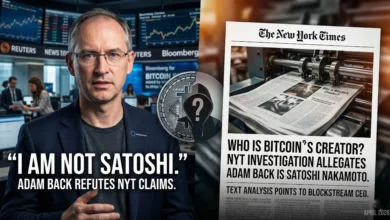
Blockstream CEO Adam Back publicly challenged the immediacy of the threat. He responded by characterizing current cryptographically relevant quantum computers as theoretical laboratory experiments. Back stated that ongoing Bitcoin research continues to evaluate post-quantum cryptography without requiring immediate, aggressive protocol alterations.
The content provided in this article is for informational and educational purposes only. It is not intended to be, and should not be construed as, financial, investment, legal, or tax advice.