

Bitwise, the San Francisco-based cryptocurrency index fund manager, recently detailed its institutional strategy for its Avalanche ETP. The firm’s executive, Matt Hougan, outlined the framework for offering professional allocators regulated exposure to the Layer 1 blockchain network.
The focus on an Avalanche-specific product indicates a shift in traditional financial structuring. Asset managers are testing institutional demand for assets outside the primary market capitalizations of Bitcoin and Ethereum. The ETP vehicle provides a traditional financial wrapper for the native AVAX asset.
Hougan’s strategy involves positioning the ETP for institutional evaluation. Professional investors require strict compliance, liquidity, and structural security when allocating capital to network tokens. The firm is targeting this specific capital flow by providing a standardized investment vehicle.
Institutional evaluation of networks like Avalanche relies heavily on infrastructure capability and transaction throughput. Bitwise’s strategy centers on bridging these technical network metrics with traditional investment standards.
ETF Mechanics and Supply-Side Implications
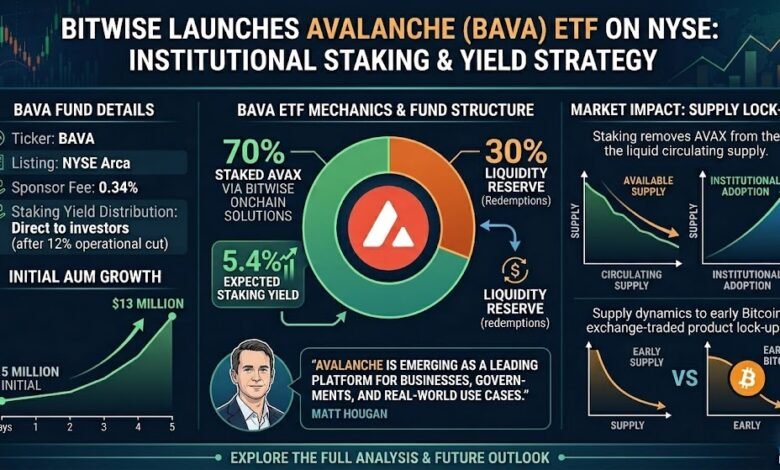
The strategy outlined by Hougan materialized on April 15, 2026, with the launch of the Bitwise Avalanche ETF under the ticker BAVA on the New York Stock Exchange. The core structural differentiator of BAVA is the integration of an in-house staking component. Bitwise allocates approximately 70% of the fund’s held AVAX to network validators through Bitwise Onchain Solutions.
This staking process targets an average yield of 5.4%, while the remaining 30% of the holdings act as a liquidity reserve to manage redemptions. “Avalanche is emerging as one of the leading platforms for businesses, governments, and real-world use cases,” Hougan said regarding the launch. “With BAVA, investors can gain exposure to an asset that we believe is powering the next wave of blockchain adoption across global finance and enterprise.”
The integration of staking alters the product’s relationship with the circulating supply of AVAX. By locking 70% of the institutional capital inflows into network validation, the fund effectively removes those tokens from the liquid market. This mechanism introduces a supply-side dynamic comparable to the capital lockups observed in early Bitcoin exchange-traded products.
BAVA launched with $2.5 million in initial assets and a 0.34% annual sponsor fee, positioning it competitively against alternative filings from asset managers like VanEck and Grayscale. Within its first days of trading, the fund’s assets under management expanded to roughly $13 million. By distributing net staking rewards directly to investors after retaining a 12% operational cut, Bitwise establishes a direct yield avenue for traditional brokerage accounts without requiring direct custody of the underlying asset.
The content provided in this article is for informational and educational purposes only. It is not intended to be, and should not be construed as, financial, investment, legal, or tax advice.