

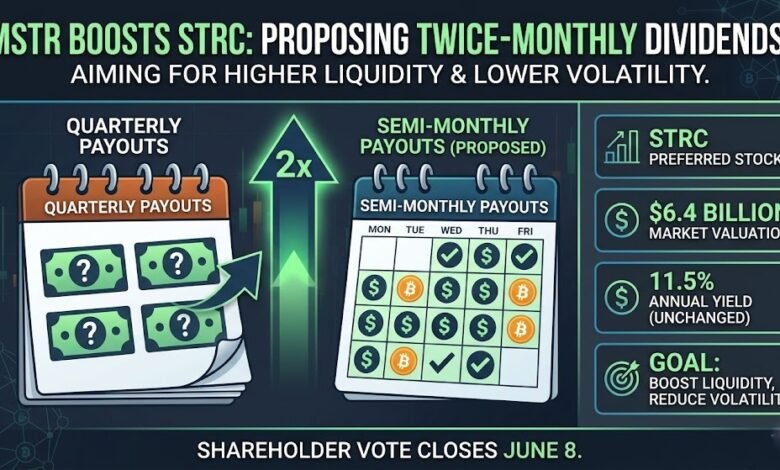
Strategy (MSTR), a leading bitcoin treasury company, has filed a proxy amendment to modify the dividend distribution timeline for its STRC “Stretch” series of preferred stock. The firm is seeking to implement a semi-monthly payout structure for investors holding the specific preferred equity.
The proposal, reported on April 17, shifts the liquidity profile of the asset by providing cash flow to shareholders twice per month. The corporate action will not alter STRC’s annual dividend obligations or its current 11.5% dividend rate.
Structural Adjustments to Yield and Volatility
Semi-monthly dividends deviate from standard quarterly or monthly distributions typically utilized in the preferred equity sector. This accelerated schedule impacts the compounding frequency for capital allocators holding STRC shares, which recently saw outstanding notional value rise to $6.4 billion.
Executive Chairman Michael Saylor stated that the proposed changes are “intended to stabilize price, dampen cyclicality, drive liquidity, and grow demand.”
Market data indicates that volatility on STRC shares has compressed to 2.1% over the past two months, down from 13% during the initial eight months following the series’ launch. Strategy management argues that doubling the payment frequency could further suppress price fluctuations.
Market Reaction and Timeline
Approval of the corporate action is contingent on shareholder consensus. Voting on the amendment will close on June 8. If passed, Strategy expects July 15 to serve as the first payment date under the revised distribution model.
The market responded to the proxy filing during Friday trading sessions. MSTR shares increased by 11.8%, moving in tandem with a 3% increase in the price of bitcoin (BTC) to $77,400. Institutional investors and yield allocators now await the June voting results to confirm the structural adjustment to the preferred stock’s capital distribution mechanics.
The content provided in this article is for informational and educational purposes only. It is not intended to be, and should not be construed as, financial, investment, legal, or tax advice.