
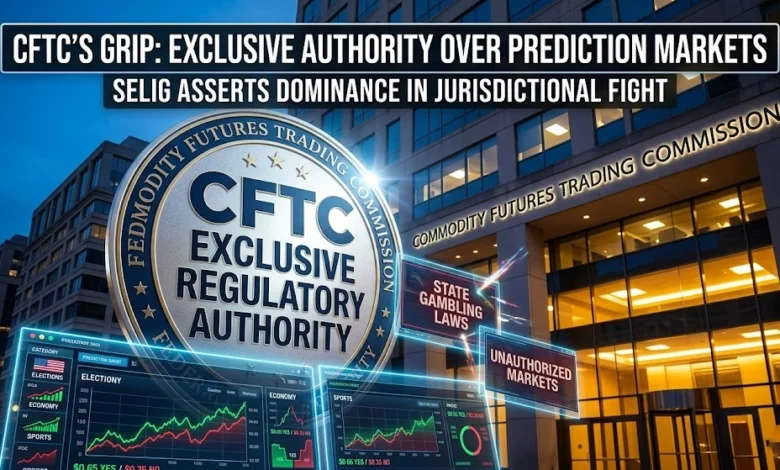
Commodity Futures Trading Commission (CFTC) Chair Mike Selig is formally asserting the agency’s right to exclusive regulatory oversight over prediction markets. The CFTC, the federal agency responsible for regulating U.S. derivatives and futures markets, is positioning itself as the definitive authority in the ongoing dispute over how to govern event-based trading platforms.
The jurisdictional friction centers on the classification of prediction market contracts. Selig’s argument indicates the agency views these instruments explicitly as derivatives falling under its statutory mandate.
Prediction markets allow users to trade shares based on the probability of specific future events occurring. By claiming exclusive authority, the CFTC aims to preempt other federal or state regulators from applying conflicting frameworks to these platforms.
The Regulatory Struggle
The push for exclusive jurisdiction highlights broader tensions in Washington over the regulation of digital assets and novel financial instruments. Without a singular authority, platforms offering event contracts face the risk of dual enforcement actions.
Industry participants require clear statutory guidelines to operate compliantly. The CFTC’s effort to solidify its position suggests upcoming policy actions or enforcement strategies designed to bring unauthorized prediction platforms strictly under its regulatory perimeter.
Escalation to Federal Courts
In a coordinated effort with the U.S. Department of Justice, the CFTC recently filed complaints in federal district courts against Arizona, Connecticut, and Illinois. The lawsuits seek to block these jurisdictions from enforcing state gambling laws against federally registered prediction markets.
The legal filings argue that the Commodity Exchange Act (CEA) preempts state legislation. The CFTC asserts that the CEA grants the agency exclusive jurisdiction over event contracts traded on designated contract markets (DCMs). Selig noted that fragmented state-level actions interfere with the federal framework and generate market uncertainty.
Dedicated Task Force and Market Advisories
To formalize its oversight, the CFTC initiated a specific rulemaking process for event contracts. Last month, the agency established an Innovation Task Force, directed by Michael J. Passalacqua, to draft compliance protocols for prediction markets, artificial intelligence, and digital assets.
Concurrently, the CFTC’s Division of Market Oversight issued an advisory to DCM operators. The directive mandates stringent surveillance mechanisms to prevent manipulation. Regulators specifically highlighted the distortion risks associated with event contracts that depend on the actions of a single individual.
The content provided in this article is for informational and educational purposes only. It is not intended to be, and should not be construed as, financial, investment, legal, or tax advice.