
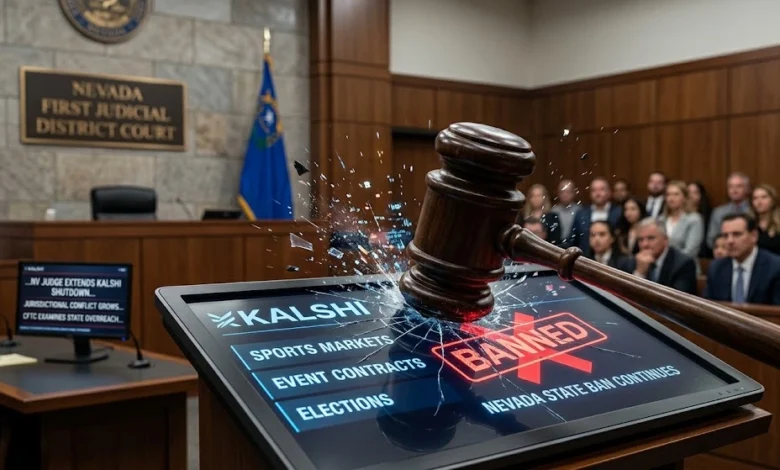
- A Nevada state judge extended a temporary ban blocking Kalshi from offering sports, entertainment, and election contracts to state residents.
- The court ruled the prediction platform’s products are “indistinguishable” from unlicensed state gaming activities.
- The decision exacerbates an ongoing jurisdictional conflict between state gaming control boards and the federal Commodity Futures Trading Commission (CFTC).
Nevada Court Sides with State Regulators
Kalshi, a federally regulated prediction market provider, faces continued operational blocks in Nevada. On Friday, Judge Jason Woodbury of the First Judicial District Court in Carson City extended a temporary restraining order against the platform by two weeks.
The extension allows time to finalize the language for a preliminary injunction requested by the Nevada Gaming Control Board. The initial order, granted on March 20, halted Kalshi from offering contracts tied to sports, entertainment, and elections within the state.
State regulators maintain that event-based contracts function as gambling products. They argue these activities require state-level licensing. Judge Woodbury agreed with this assessment during the Friday hearing. He stated that purchasing a contract on a baseball game via Kalshi is “indistinguishable” from betting on a regulated state gaming platform.
“So I find based on the arguments that have been presented that it is a gaming activity that is prohibited for any non-licensee to engage in,” Judge Woodbury said. Spokespeople for Kalshi and the Nevada Gaming Control Board did not return requests for comment.
The Federal vs. State Jurisdictional Clash
The Nevada ruling highlights a widening legal dispute over who possesses the authority to regulate prediction markets. Kalshi and competing platforms operate under the premise that their products are swaps. As designated contract markets, they argue their operations fall strictly under federal jurisdiction, specifically bypassing state gaming authorities.
The CFTC supports this classification. Under Chairman Mike Selig, the agency has actively defended its exclusive regulatory oversight of these derivative products. The CFTC filed an amicus brief in an appeals court case earlier this year defending the federal framework.
Federal authorities escalated their defense on Thursday. The CFTC, in coordination with the Department of Justice, filed lawsuits against Arizona, Illinois, and Connecticut. The federal complaint alleges these states are actively infringing on the CFTC’s statutory role by attempting to regulate or block prediction markets locally.
Concurrent Legal Action in Arizona
The jurisdictional fight is advancing simultaneously across multiple states. On the same day as the Nevada decision, a federal court in Arizona held a separate hearing regarding Kalshi’s operations.
Kalshi filed a motion to prevent Arizona state regulators from blocking its products. This follows actions by Arizona Attorney General Kris Mayes, who previously filed information alleging criminal charges against the prediction market provider. District Judge Michael Liburdi heard the arguments in the Arizona case and is currently considering the motion.
The content provided in this article is for informational and educational purposes only. It is not intended to be, and should not be construed as, financial, investment, legal, or tax advice.