

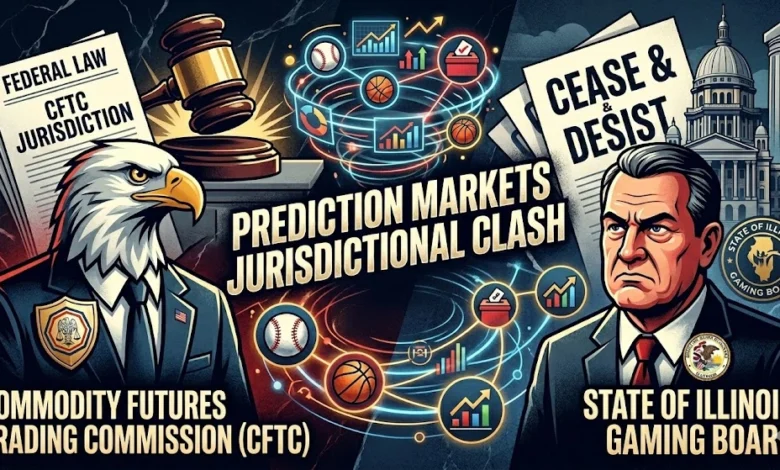
CFTC and DOJ Sue Illinois Over Prediction Market Jurisdiction
The Commodity Futures Trading Commission (CFTC) and the U.S. Department of Justice (DOJ) filed a lawsuit against the state of Illinois on April 2, 2026. The litigation names Governor J.B. Pritzker, Attorney General Kwame Raoul, and members of the Illinois Gaming Board as defendants. The federal agencies seek a permanent injunction to prevent the state from applying its gambling laws to federally licensed prediction markets.
Illinois authorities previously issued cease-and-desist letters to platforms operating as Designated Contract Markets (DCMs), including Kalshi, Polymarket, Crypto.com, and Robinhood. State regulators alleged these entities facilitated unlicensed sports wagering.
The legal dispute centers on federal preemption and the financial classification of event contracts. Prediction markets allow participants to trade contracts based on future event outcomes. The CFTC asserts exclusive federal oversight over these instruments under the Commodity Exchange Act of 1974, legally defining them as derivative swaps rather than bets.
Federal Preemption vs. State Gaming Laws
The federal complaint argues that Illinois is improperly attempting to regulate national swaps markets. The CFTC maintains that state-level enforcement forces DCMs into a fragmented regulatory system, violating the unified federal framework established by Congress.
“This comprehensive federal regulatory scheme preempts Illinois law as applied to event contracts traded on federally regulated exchanges,” the plaintiffs stated in the court filing. The agencies argue that conditioning DCM operations on state gambling compliance directly interferes with federal authority.
Illinois views sports event contracts as wagers subject to state gaming regulations and taxes. The state recently introduced legislation aimed at banning sports-related trades and imposing strict age restrictions on prediction platforms operating within its borders.
Broader Multi-State Legal Action
The lawsuit against Illinois is part of a wider federal enforcement action. The CFTC filed nearly identical lawsuits against Arizona and Connecticut on Thursday. Both states had also targeted prediction market operators, with Arizona recently filing criminal charges against Kalshi.
CFTC Chairman Michael Selig characterized the legal actions as a necessary defense of federal jurisdiction. “The CFTC will continue to safeguard its exclusive regulatory authority over these markets and defend market participants against overzealous state regulators,” Selig said.
The federal courts will now determine whether the Commodity Exchange Act supersedes state gambling statutes for licensed prediction markets. The outcome will establish the legal framework for how event contracts are governed across the United States.
The content provided in this article is for informational and educational purposes only. It is not intended to be, and should not be construed as, financial, investment, legal, or tax advice.