
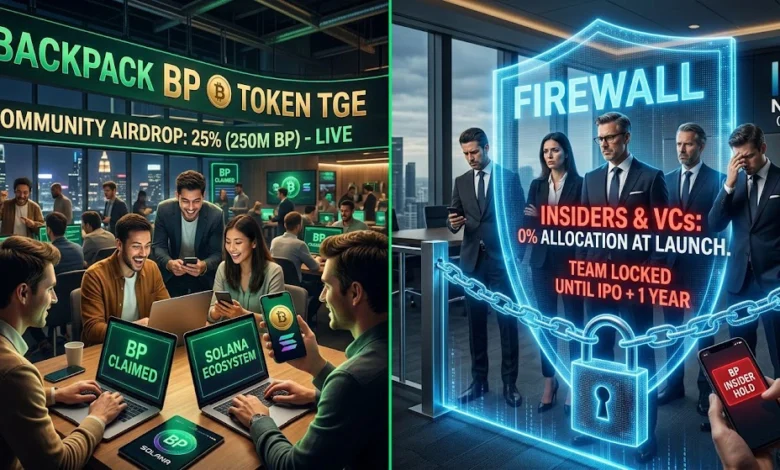
Backpack launched its native BP token with a 1 billion total supply, distributing 25% immediately and exclusively to the community.Zero tokens are available to insiders at launch; team and investor allocations are strictly locked until a prospective corporate IPO.The Solana-based exchange purged over 50 million “fake points” ahead of the drop, protecting legitimate retail liquidity.
Money usually flows one way in crypto token launches: from the retail public straight into the wallets of early venture capitalists. Backpack, a prominent wallet and centralized exchange in the Solana ecosystem, is attempting to rewrite that tired script. On March 23, the company executed its BP Token Generation Event (TGE), and the underlying mechanics signal a sharp pivot from standard industry cash grabs.
Let’s look at the cap table. The total supply of BP is capped at 1 billion tokens. What matters is the initial circulation. Exactly 25% 250 million tokens hit the market at the TGE. Every single one of those tokens went to community users, split between platform point holders (24%) and Mad Lads NFT owners (1%).
The Zero-Insider Policy
The most striking data point isn’t the size of the airdrop. It is the absolute zero allocated to the cap table heavyweights.
Backpack founder Armani Ferrante emphasized that “no founder, executive, team member, or venture investor received direct token allocations.” Instead, the entire team’s allocation sits in the corporate treasury, fully locked. They cannot touch these assets to extract early retail liquidity.
Founders and venture backers are barred from profiting until the company launches its anticipated Initial Public Offering (IPO) in the United States. Even then, treasury funds face an additional one-year lockup post-IPO. This structure forces the internal team to treat the company as a traditional equity play rather than a quick crypto flip.
Milestone-Driven Unlocks
The remaining token supply relies on a strict vesting schedule tied to actual business growth, not just the passage of time.
Backpack reserved 37.5% of the total supply to be unlocked before the IPO, but these releases depend entirely on measurable milestones. The company must prove tangible expansion, such as securing new regulatory approvals in the EU, Japan, or the U.S., or rolling out new products like margin trading and debit cards. The final 37.5% unlocks post-listing.
Before the BP token went live, the exchange audited its internal metrics. Data analysis identified and purged over 50 million “fake points” generated by sybil attackers. This aggressive defense of the cap table protected the integrity of the ecosystem, which processed a massive $4.33 trillion in total trading volume during the airdrop farming phase.
Institutional Implications
This tokenomics model bridges the gap between decentralized community incentives and traditional Wall Street equity structures. By locking insider tokens behind an IPO wall, Backpack aligns its corporate executives directly with its retail user base. If the exchange fails to secure public market entry, the insiders hold the bag, not the retail traders.
We are watching a structural shift. If Backpack successfully navigates this dual-track model of a liquid community token and a traditional equity exit, it could force other heavily backed crypto infrastructure plays to abandon the quick-dump playbook.
The content provided in this article is for informational and educational purposes only. It is not intended to be, and should not be construed as, financial, investment, legal, or tax advice.