

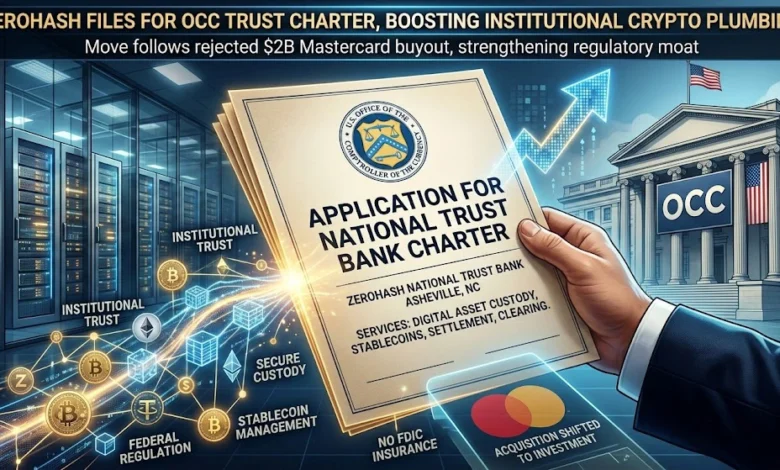
Zero Hash has filed with the OCC to launch a federally regulated national trust bank in Asheville, North Carolina, strictly to handle digital asset custody, stablecoins, and settlement.The proposed charter deliberately excludes retail deposits, loans, and FDIC insurance, cementing the firm’s role as a purely institutional, back-end service provider.
The filing arrives shortly after Zero Hash rejected a $2 billion outright acquisition offer from Mastercard, signaling the firm’s intent to build a standalone regulatory moat. Wall Street’s back-office plumbing is quietly being rebuilt, and the firms supplying the pipes are aggressively upgrading their credentials.
Zero Hash, the Chicago-based digital asset infrastructure provider powering the crypto operations for financial heavyweights like Morgan Stanley, Stripe, and BlackRock, is making a definitive play for federal oversight. Recently, the company submitted an application to the Office of the Comptroller of the Currency (OCC) to establish a de novo national trust bank.
If approved, the newly formed entity officially proposed as “zerohash national trust bank” (ZNTB) will be based in Asheville, North Carolina. It marks a critical pivot for the company. By moving from a patchwork of state-by-state money transmitter licenses toward a unified federal framework, Zero Hash is positioning itself to capture the massive influx of institutional capital currently entering the digital asset sector.
The Strategy Behind the Charter
The OCC filing reveals exactly how Zero Hash plans to operate under federal watch. The proposed bank is highly specialized. It will offer custody for crypto and fiat currencies, custodial staking, trade execution, stablecoin management, and clearing services.
Crucially, the filing explicitly outlines what the bank will not do. ZNTB will not take retail deposits. It will not originate loans. It will not seek FDIC insurance.
By stripping away traditional commercial banking functions, Zero Hash is minimizing its systemic risk profile in the eyes of federal regulators. The goal is straightforward: provide the highly regulated, secure infrastructure that legacy financial institutions require before they can interact with tokenized assets and stablecoins.
Stephen Gardner, Zero Hash’s Chief Legal and Compliance Officer and the proposed CEO for the new trust bank made the corporate rationale clear. “Applying for a National Trust Bank Charter is a natural next step in offering robust global licensing coverage and continuing to expand our product offering,” Gardner noted in a statement.
Follow the Money: The Mastercard Connection
To understand the weight of this OCC filing, you have to look at the money flowing around Zero Hash. The company is already the invisible engine behind major market deployments, handling the complex logistics of tokenized products for platforms like Interactive Brokers and prediction market Kalshi.
But the real indicator of the firm’s market leverage surfaced earlier this year. Mastercard approached Zero Hash with an outright acquisition offer reportedly worth up to $2 billion. Zero Hash turned the buyout down.
Choosing independence over a multi-billion-dollar exit suggests internal confidence in a much larger, long-term valuation. Instead of an acquisition, Mastercard and Zero Hash are now negotiating a strategic investment. This allows Mastercard to maintain exposure to Zero Hash’s technology and blue-chip client base, while Zero Hash retains its autonomy to build a federally chartered monopoly in the background.
Institutional Maturation
Zero Hash is not the first crypto-native firm to seek a federal trust charter, but its timing aligns with a rapidly maturing regulatory environment under the current administration. Late last year, the OCC granted conditional trust charter approvals to heavyweights like Ripple, Circle, and BitGo.
By joining this exclusive queue, Zero Hash is signaling to its traditional finance partners that it can meet them at their level of compliance. As asset managers and legacy banks continue to tokenize real-world assets and deploy stablecoins, they require vendors that operate under the exact same stringent federal guidelines they do. For Zero Hash, securing this charter isn’t just about regulatory compliance; it is the ultimate institutional sales pitch.