
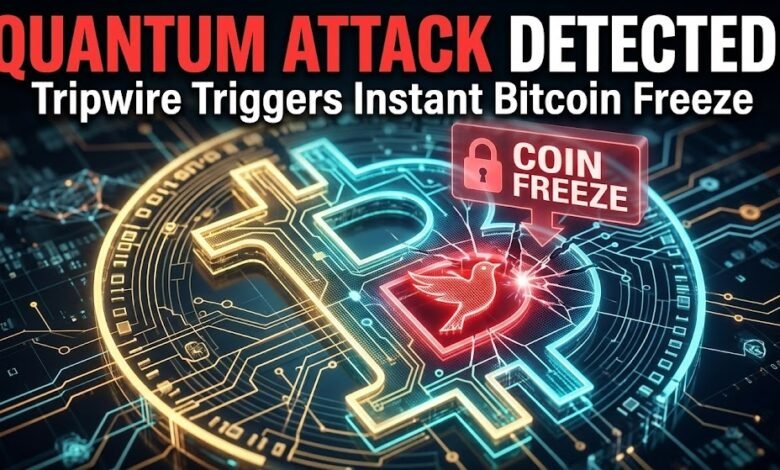
Bitcoin developers the decentralized network of software engineers who maintain the underlying Bitcoin protocol are evaluating a new defensive mechanism. According to reports dated April 16, 2026, the group is floating a “quantum tripwire” concept designed to mitigate potential vulnerabilities associated with quantum computing advancements.
The proposed mechanism targets the transaction layer of the network. Published by BitMEX Research, the proposal introduces a “canary” system. It involves placing a specific bounty of Bitcoin into an address that requires quantum computing capabilities to unlock.
If these funds are spent, the protocol recognizes it as cryptographic proof that Bitcoin’s digital signature scheme has been compromised. This action automatically triggers a network-wide freeze on older, vulnerable wallets.
BIP-361 vs. The Canary Mechanism
The canary system is designed as a direct alternative to Bitcoin Improvement Proposal 361 (BIP-361). BIP-361 proposes a fixed five-year timeline to phase out vulnerable addresses, regardless of whether a quantum threat has materialized.
Failure to migrate funds under the BIP-361 framework would result in older signature schemes becoming invalid, permanently freezing an estimated 5.6 million BTC. The canary proposal avoids this pre-scheduled intervention. Instead, it assumes an attacker will claim the public bounty rather than executing stealth attacks on the ledger.
The “Safety Window” and Execution
To deter unannounced stealth exploits, the BitMEX proposal includes a temporal “safety window.” Under this parameter, vulnerable coins can still be moved on-chain, but the recipient is unable to spend them for a designated period, estimated at around a year.
If a quantum attacker triggers the canary address during this time lock, the protocol retroactively freezes the transferred coins. This data structure increases the financial risk for any entity attempting to extract funds quietly.
Zk-STARK Recovery Prototype
Parallel to the network-level tripwire discussions, protocol engineers are testing localized wallet recovery solutions. Lightning Labs Chief Technology Officer Olaoluwa Osuntokun recently introduced a working prototype utilizing zk-STARK cryptographic proofs.
The prototype allows users to verify wallet ownership via their seed phrase derivation path without exposing private keys. If a quantum emergency forces the network to disable standard signature methods, this zk-STARK implementation enables users to recover and migrate their funds safely. Initial testing indicates the verification process generates a 1.7MB proof and requires approximately 50 seconds on standard consumer hardware.
The content provided in this article is for informational and educational purposes only. It is not intended to be, and should not be construed as, financial, investment, legal, or tax advice.






One Comment