
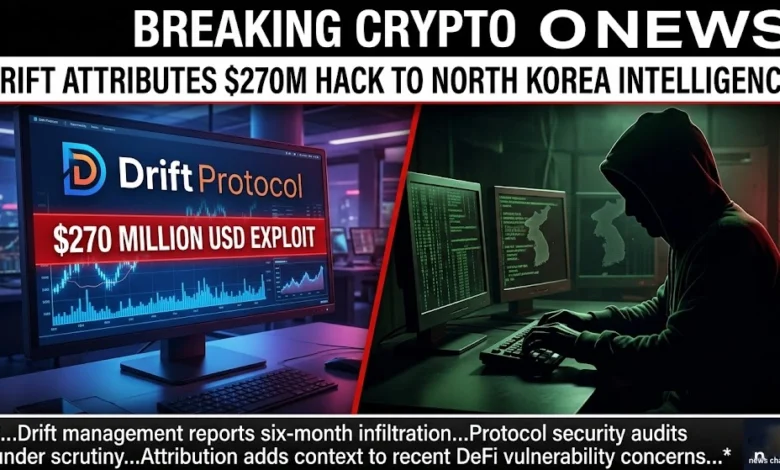
- Drift management claims a recent $270 million exploit was orchestrated by North Korean intelligence over a six-month period.
- The extended timeframe raises immediate questions regarding the efficacy of the protocol’s routine security audits and internal monitoring.
- Attributing protocol breaches to state-sponsored actors remains a standard, yet difficult to independently verify, crisis response strategy in the decentralized finance sector.
Drift Attributes $270M Loss to Six-Month North Korean Operation
Drift, the decentralized finance trading protocol, announced on April 5 that its recent $270 million exploit was the culmination of a six-month intelligence operation directed by North Korea.
The assertion places the blame for the nine-figure loss squarely on state-sponsored actors. However, the specified timeframe of the operation introduces significant questions regarding the protocol’s internal security infrastructure. A six-month infiltration implies that malicious actors maintained access or probed vulnerabilities across multiple financial quarters without triggering internal alarms.
Security Audits Under Scrutiny
Decentralized exchanges typically undergo regular smart contract audits and employ constant on-chain monitoring to detect anomalous behavior. If North Korean operatives were actively manipulating or researching the protocol’s architecture for half a year, the failure to detect this activity points to severe deficiencies in Drift’s threat detection systems.
The protocol’s management has not yet released the detailed post-mortem data required to verify the six-month timeline. Independent blockchain security firms have yet to corroborate the specific attribution to North Korean intelligence.
The State-Actor Defense
Within the digital asset sector, attributing catastrophic security failures to the Lazarus Group or other North Korean state entities is a common post-exploit narrative. While North Korean hackers are undeniably active and responsible for billions in stolen digital assets, assigning them responsibility also serves a secondary function for compromised protocols.
Blaming a sophisticated nation-state often shifts the public focus away from fundamental coding errors, inadequate multisig controls, or negligence by the protocol’s core developers.
Drift’s users currently await a transparent technical breakdown of the exploit vector. Until on-chain forensic data is published and peer-reviewed by third-party security researchers, the six-month state-sponsored operation narrative remains an unverified claim from the compromised entity itself.
The content provided in this article is for informational and educational purposes only. It is not intended to be, and should not be construed as, financial, investment, legal, or tax advice.