

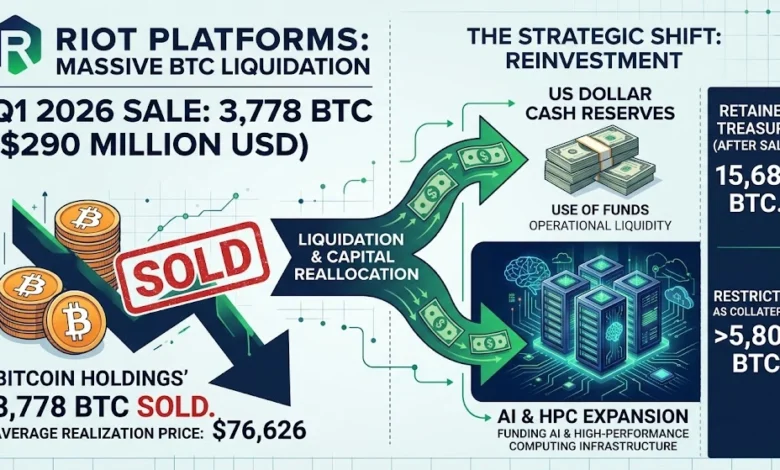
- Riot Platforms liquidated 3,778 BTC during the first quarter of 2026, realizing $289.5 million.
- The firm retains a treasury of 15,680 BTC, though over 5,800 BTC remains restricted as collateral.
- The sale aligns with a sector-wide capital reallocation by miners toward Artificial Intelligence (AI) and High-Performance Computing (HPC) infrastructure.
Riot Platforms Liquidates $290 Million in Bitcoin Reserves
Riot Platforms, the Nasdaq-listed industrial Bitcoin mining operator, has sold approximately $290 million worth of its Bitcoin holdings. According to the firm’s first-quarter 2026 operations update, Riot sold exactly 3,778 BTC. The execution achieved an average realization price of $76,626 per Bitcoin.
Large-scale liquidations by major mining operations function as key indicators of supply-side market dynamics. A $290 million sale introduces significant liquidity into the market. The execution method—whether routed through over-the-counter (OTC) trading desks or distributed across spot exchanges—determines the immediate impact on order books and short-term price action.
Following the first-quarter sale, Riot’s balance sheet retains 15,680 BTC, valued at approximately $1.1 billion at quarter-end. However, 5,802 BTC of this remaining treasury is actively pledged as collateral, restricting its immediate liquidity for further operational deployment.
Sector Rotation: AI and HPC Diversification
Industrial miners accumulate block rewards on their balance sheets. Converting these digital assets into USD is a standard financial mechanism used to fund capital-intensive operations. While historically allocated to energy procurement and ASIC hardware upgrades, current institutional money flows indicate a structural pivot.
The Q1 capital realization by Riot Platforms corresponds with a broader trend across the industrial mining sector. Major mining entities are actively liquidating portions of their digital asset reserves to finance diversification into Artificial Intelligence (AI) and High-Performance Computing (HPC) infrastructure. This operational shift allows mining firms to leverage their existing megawatt capacity and secure alternative, non-correlated revenue streams outside of standard proof-of-work economics.
The content provided in this article is for informational and educational purposes only. It is not intended to be, and should not be construed as, financial, investment, legal, or tax advice.