

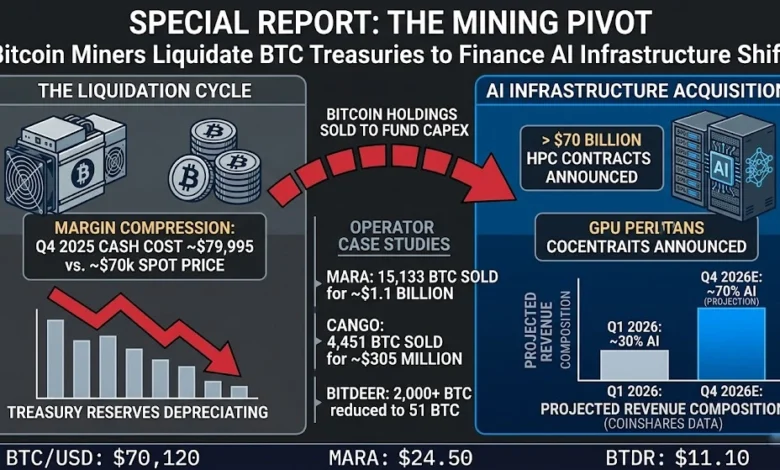
Bitcoin mining operators are pivoting their primary business models toward Artificial Intelligence computing.To fund this transition, firms are actively liquidating their Bitcoin reserves.The sell-off introduces a new variable for market liquidity and spot price action. Bitcoin mining operations the data centers equipped with specialized hardware that validate transactions and secure the Bitcoin network are increasingly transitioning into Artificial Intelligence computing companies. According to Q1 2026 industry data, these firms are systematically selling off their accumulated Bitcoin (BTC) holdings to finance the shift.
The transition to AI infrastructure requires significant capital expenditure. Miners must retrofit existing facilities or build new ones equipped with high-performance GPUs suitable for AI workloads. To secure the necessary capital for these upgrades, operators are tapping into their primary asset base.
Margin Compression Drives Strategic Shift
The economics of pure-play mining have deteriorated, forcing operators to seek alternative revenue streams. In the fourth quarter of 2025, the weighted-average cash cost to produce one Bitcoin among publicly listed miners reached approximately $79,995, according to CoinShares data. Meanwhile, the spot price of the asset currently fluctuates near $70,000, placing the industry average underwater.
This profitability gap is compounded by a declining hashprice, which measures the revenue a miner earns per unit of computing power. Hashprice dropped to between $28 and $30 per petahash per second per day in the first quarter of 2026. Consequently, operators are reallocating capital toward High-Performance Computing (HPC) and AI data centers. This sector currently accounts for over $70 billion in new infrastructure contracts across public mining firms.
Major Operators Liquidate Treasuries
Public mining companies, which collectively held an estimated 121,516 BTC earlier this year, are unwinding these positions at a rapid pace. MARA Holdings recently liquidated 15,133 BTC for approximately $1.1 billion. The firm utilized these funds to repurchase $1 billion in convertible notes, reducing its debt by 30% and freeing capital for AI expansion.
Other prominent operators are executing similar strategies to manage liquidity and fund facility retrofits. Cango recently sold 4,451 Bitcoin for $305 million to pay down a collateralized loan and finance its own AI transition. Similarly, Bitdeer depleted its treasury from over 2,000 tokens at the end of 2025 to just 51 by late February 2026.
Long-Term Impact on Market Supply
This aggressive selling behavior alters the traditional assumption that public miners act as permanent accumulators of the asset. When margins break, operators manage liquidity like traditional commodity producers. This dynamic means treasury liquidations often become pro-cyclical, placing additional downward pressure on the spot market during periods of price weakness.
Industry analysts expect this structural reallocation to permanently alter miner revenue models. According to James Butterfill, Head of Research at CoinShares, listed miners “could derive as much as 70% of their revenues from AI by the end of this year, up from roughly 30% today.”
The content provided in this article is for informational and educational purposes only. It is not intended to be, and should not be construed as, financial, investment, legal, or tax advice.