

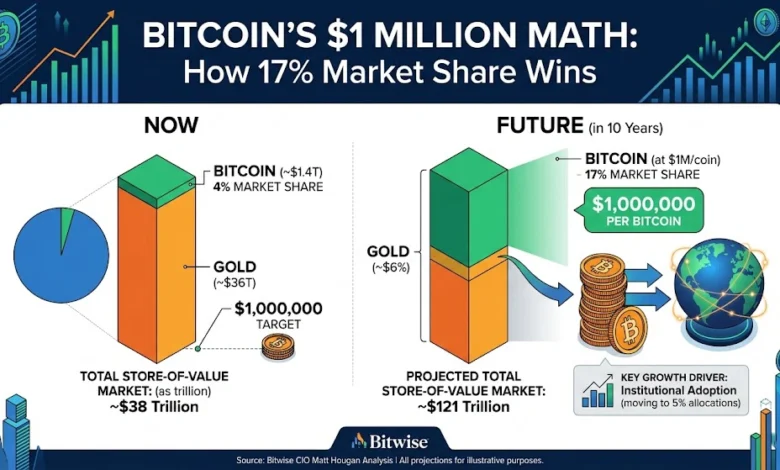
Bitcoin only needs to capture 17% of a projected $121 trillion store-of-value market to hit $1 million per coin over the next decade.The total wealth preservation market is growing rapidly, up from $2.5 trillion in 2004 to roughly $38 trillion today, drastically easing the market share Bitcoin needs for seven-figure pricing. With volatility dropping and ETFs open, institutional target allocations are creeping from 1% up to 5%, providing the necessary capital flow for massive price appreciation.
Bitwise Asset Management, a prominent crypto index fund manager, has once again put a controversial number on the table. Matt Hougan, the firm’s Chief Investment Officer, recently published a memo outlining exactly how Bitcoin could hit $1 million. The argument ignores short-term trading cycles. Instead, it focuses heavily on global wealth flows and the evolving definition of defensive assets.
Most retail traders fixate on current market caps. Institutional money looks at market share and total addressable market expansion. Right now, the global store-of-value market sits at roughly $38 trillion. Gold dominates with $36 trillion. Bitcoin claims about $1.4 trillion, a mere 4% slice of the pie.
If the market size stayed frozen, Bitcoin would have to eat half of gold’s lunch to hit $1 million. But the market isn’t frozen.
The 2004 Gold Blueprint
Capital is constantly fleeing fiat depreciation. “One million sounds crazy,” Hougan noted in his recent commentary. “It implies bitcoin will rise 14x from today’s price.”
To understand why institutions take this projection seriously, look at gold. When the first U.S. gold ETF launched in 2004, the entire gold market was valued at around $2.5 trillion. Today, fueled by massive government debt issuance, geopolitical stress, and persistent loose monetary policy, that same market is nearing $40 trillion. That represents a 13% compound annual growth rate over two decades.
If that growth trajectory holds, the global wealth preservation sector will balloon to roughly $121 trillion within ten years. At that expanded size, Bitcoin only needs to secure a 17% market share to cross the $1 million threshold.
Wall Street’s Shifting Allocations
The infrastructure to handle this capital migration is finally built. Spot ETFs broke the dam. Sovereign wealth funds and massive endowments are already quietly establishing positions.
We are seeing a structural shift in risk assessment. Historically, progressive portfolio managers suggested a 1% allocation to digital assets. Today, thanks to declining long-term volatility and highly regulated entry points, those target allocations are inching toward 5%. This seemingly small percentage shift unlocks billions in fresh capital.
Debating the Timeline
While the math checks out for many market insiders, the timeline remains heavily debated. The consensus on Wall Street and in Silicon Valley is fracturing over when this capital shift completes, not if it happens.
Recently, Coinbase CEO Brian Armstrong projected the milestone could arrive by 2030. Former BitMEX CEO Arthur Hayes aggressively targeted 2028. Bernstein analysts modeled it for 2033, while Ark Invest remains the outlier, forecasting a multi-million dollar price tag by the decade’s end.
The timeline ultimately depends on macroeconomic pressures. If fiat debasement accelerates, the wealth preservation market expands faster.
“As I see it, the base case — that the store-of-value market will continue to grow as it has, and bitcoin will continue to gain market share as it has — leads you to much, much higher prices than we have today,” Hougan stated.
The content provided in this article is for informational and educational purposes only. It is not intended to be, and should not be construed as, financial, investment, legal, or tax advice.