
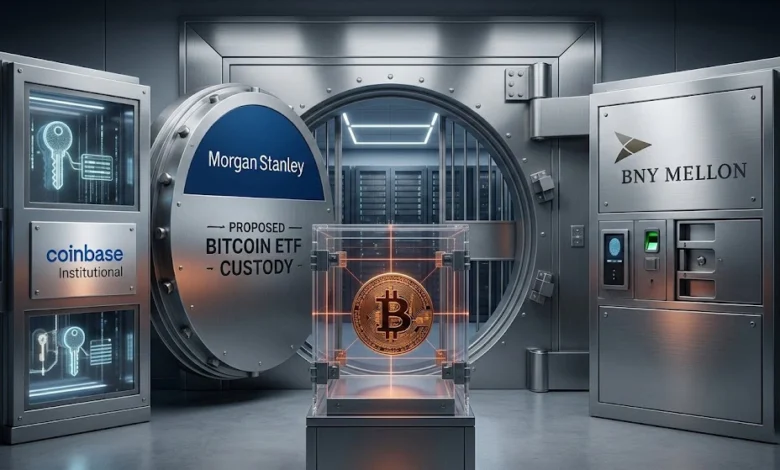
- Morgan Stanley is moving forward with a proposed Bitcoin ETF, adding massive institutional weight to the asset class.
- The bank has selected both Coinbase and BNY Mellon to manage the custody of the fund.
- The dual-custodian setup will handle everything from basic asset storage to the mechanics of share creation and redemption.
The Plumbing Behind the Capital
It is one thing for a major financial institution to acknowledge digital assets; it is another entirely to build the plumbing for a dedicated fund.
Morgan Stanley, the global investment banking titan managing trillions in client wealth, is structuring its own proposed Bitcoin exchange-traded fund (ETF). Rather than attempting to build an in-house vault from scratch, the firm is outsourcing the heavy lifting to established players.
Recently, the bank formally tapped Coinbase and BNY Mellon to manage the underlying assets for the proposed fund.
Structuring the Trust
An ETF is only as strong as its custody arrangement. Institutional money will not flow into a product if there is any ambiguity about where the assets actually sit.
By pairing a crypto-native platform with one of the oldest traditional banks in the United States, Morgan Stanley is structuring a highly specific operational flow. According to the release, “The two institutions will serve as the trust’s bitcoin custodians, responsible for storing the digital assets and facilitating transfers related to share creations and redemptions.”
The Custodial Mechanics
This arrangement means Coinbase and BNY Mellon are doing much more than just holding the digital keys in cold storage.
They are actively managing the daily operational liquidity. When institutional demand requires new shares of the ETF to be created, or when investors decide to cash out and redeem their shares, these two custodians are the ones executing the actual transfers of Bitcoin to keep the fund balanced.
From a market perspective, bringing BNY Mellon and Coinbase to the same table shows exactly how institutional capital plans to handle digital assets moving forward: by bridging the old world of finance directly with the new.
The content provided in this article is for informational and educational purposes only. It is not intended to be, and should not be construed as, financial, investment, legal, or tax advice.