
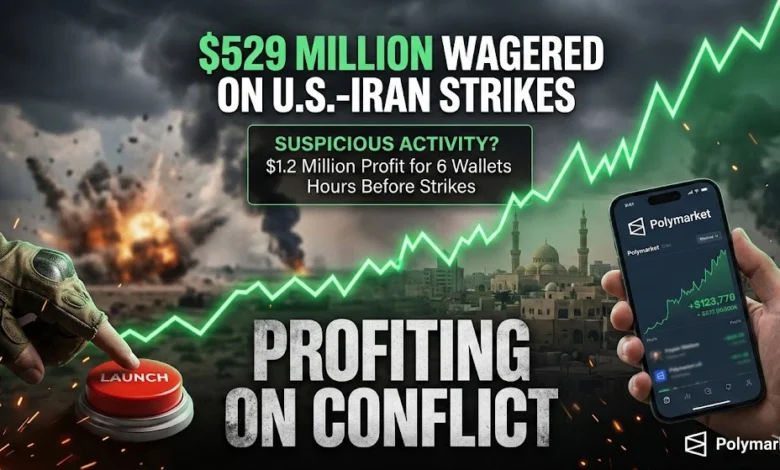
Polymarket saw $529 million wagered on the timing of U.S. military strikes on Iran, turning the conflict into a highly lucrative trading floor. Six highly suspicious wallets netted $1.2 million in profits right before the military action, raising serious questions about insider trading. While the platform touts its markets as “harnessing the wisdom of the crowd,” the rapid monetization of geopolitics points to a darker reality of war profiteering.
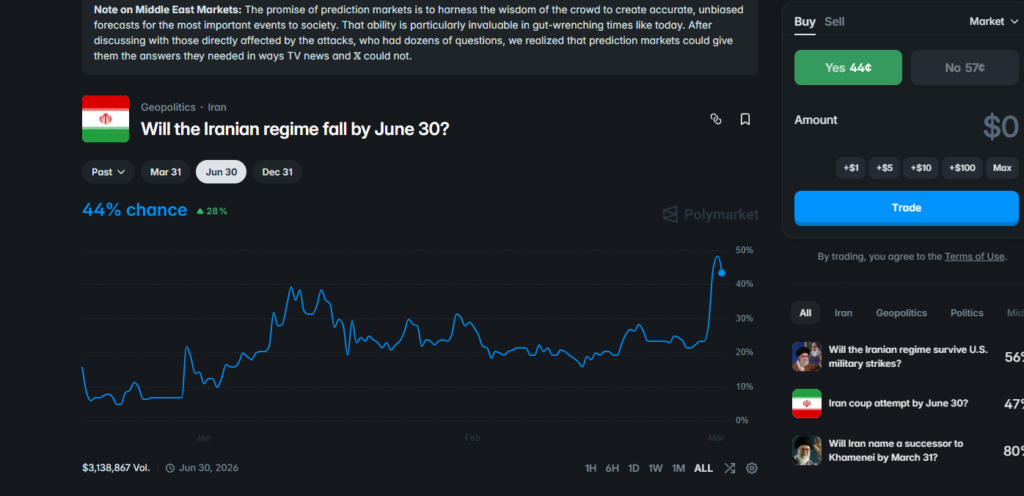
Polymarket, the crypto-based prediction market platform, took less than 24 hours to turn a geopolitical crisis in the Middle East into an active financial casino. Following recent U.S. and Israeli strikes on Iran, the platform was inundated with new betting contracts. Traders are no longer just watching the news unfold. They are actively pricing ceasefire timelines, wagering on whether the Iranian regime will collapse by June, and betting on whether U.S. ground forces will enter the country by March 7.
The speed of this financialization is unsettling. War is no longer just a matter of global security; it is a high-stakes binary options market.
The $529 Million Question
The platform’s biggest draw wasn’t a presidential election or an economic policy shift. It was a contract titled “US strikes Iran by…?”, which had been active since December 22. This specific market pulled an astonishing $529 million in total volume. It now ranks as one of the largest single markets Polymarket has ever hosted.
The resolution rules for the payout were cold and highly specific. A winning ticket required concrete U.S. drone, missile, or air strikes on Iranian soil. Interceptions, cyberattacks, or ground operations would not trigger a payout. When the strikes commenced, every daily contract from February 28 into early March resolved to “yes.” Anyone who correctly timed the bombing of a sovereign nation walked away richer.
Another massive market focused on the country’s leadership: “Khamenei out as Supreme Leader of Iran by March 31?” The market resolved to 100% following confirmation of his death by Iranian state TV on Saturday. That single contract handled $45 million in volume. An account under the alias “Curseaaaaaaa” secured a massive $757,000 profit from a “yes” bet, while four other users walked away with six-figure payouts.
Suspicious Timing and the Insider Problem
While massive betting volume raises obvious ethical questions, the blockchain data reveals a far more troubling issue: suspicious timing.
On Saturday, onchain analytics firm Bubblemaps reported that six specific wallets collectively netted $1.2 million in pure profit by wagering on a U.S. strike occurring exactly on February 28. Most of these wallets were funded within a 24-hour window prior to the attack. They didn’t bet on broad timeframes. Instead, they purchased “yes” shares for the February 28 contract mere hours before the military operation started.
One single wallet transformed an initial $61,000 stake into over $493,000 in profit.
When newly funded, anonymous accounts start predicting classified military actions with pinpoint accuracy just hours before missiles launch, we have to look past the concept of a lucky guess.
The “Wisdom of the Crowd”
Platform operators maintain a distinctly optimistic view of their product. In a note added to its Middle East markets on Sunday, Polymarket claimed that “the promise of prediction markets is to harness the wisdom of the crowd to create accurate, unbiased forecasts for the most important events to society.”
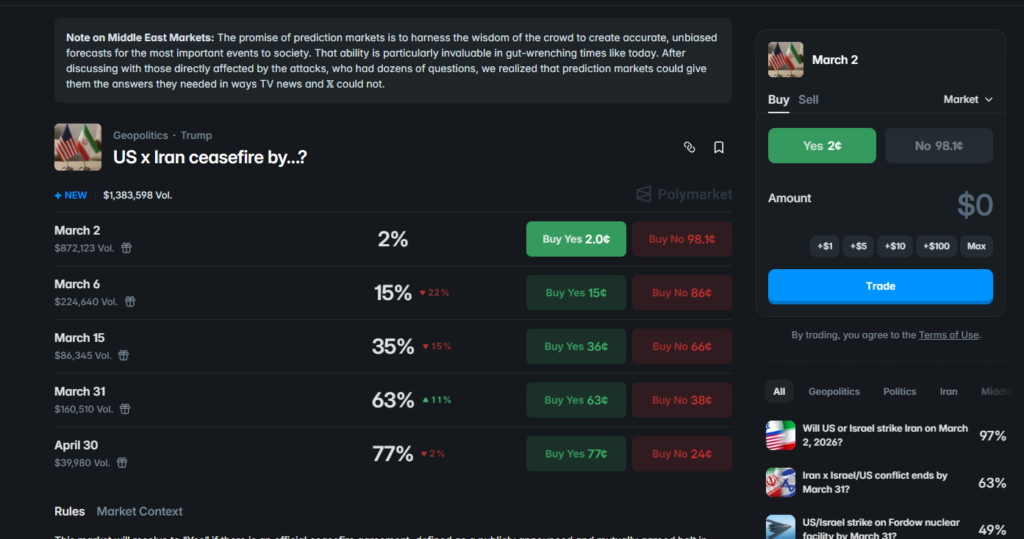
Yet, looking closely at the data, one has to wonder if this is truly the wisdom of the crowd or the privilege of a few insiders exploiting highly classified military intelligence. Bettors are already pricing the aftermath. Current markets suggest a 61% chance of a U.S.-Iran ceasefire by March 31, and a 78% chance by April 30.
Prediction markets offer undeniable utility in capturing public sentiment. But when a platform effectively crowdsources the financialization of military conflict and potentially rewards those with advance knowledge of bombings, the line between an “unbiased forecast” and a morally ambiguous shadow market becomes very thin.
The content provided in this article is for informational and educational purposes only. It is not intended to be, and should not be construed as, financial, investment, legal, or tax advice.