

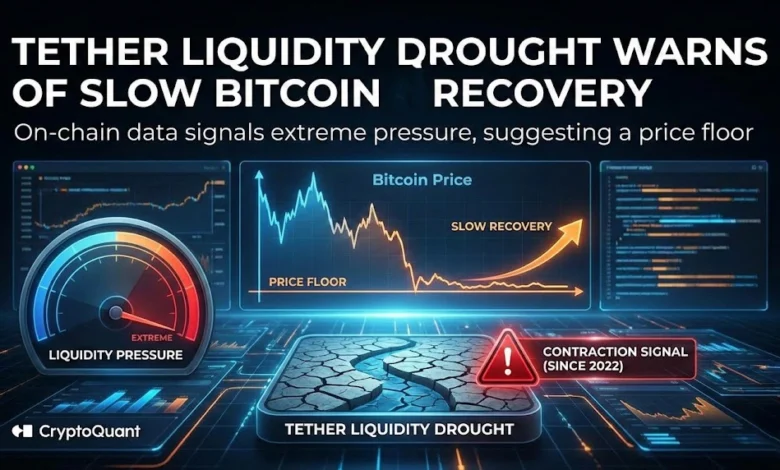
Tether’s liquidity metrics have flashed a rare contraction signal not seen since the crypto market bottom of 2022. On-chain data from CryptoQuant points to extreme liquidity pressure, suggesting Bitcoin may be finding its price floor.
Unlike previous cycles,
Coin Bureau, the widely followed cryptocurrency education and market analysis platform, is currently attached to a rather hollow piece of digital evidence. Recently, a lone URL pointing to a specific status on X (formerly Twitter) surfaced under their handle.
What does this source actually tell us? Nothing at all.
We have a status ID and a platform name. That is the entirety of the verifiable data. There are no price targets, no breaking news of institutional adoption, and no warnings of impending market liquidations. Just an isolated link.
In an industry driven by whispers and algorithmic overreactions, an empty link acts as a blank canvas. Traders often rush to fill these voids with their own speculative biases. Why was this specific URL circulated without any supporting context? Is it a placeholder, a deleted post, or merely a clerical error in data transmission?
The only tangible text we can extract from the provided material is the address itself: “https://x.com/coinbureau/status/2025834259777261659“.
Without dates, figures, or explicit claims, there is no foundation for investment analysis here. As market participants, we must demand hard data rather than reacting to the mere presence of a digital footprint. Until the actual substance behind this URL is revealed, it remains a cryptographic zero.
The Liquidity Drought: What Tether’s Rare Signal Means for Capital Flows
Tether (USDT), the dominant stablecoin serving as the primary fiat gateway and liquidity engine for the global cryptocurrency market, is flashing a severe warning sign. Recently, USDT triggered a rare on-chain metric indicating extreme liquidity pressure a contraction phenomenon last witnessed during the depths of the 2022 Bitcoin bottom.
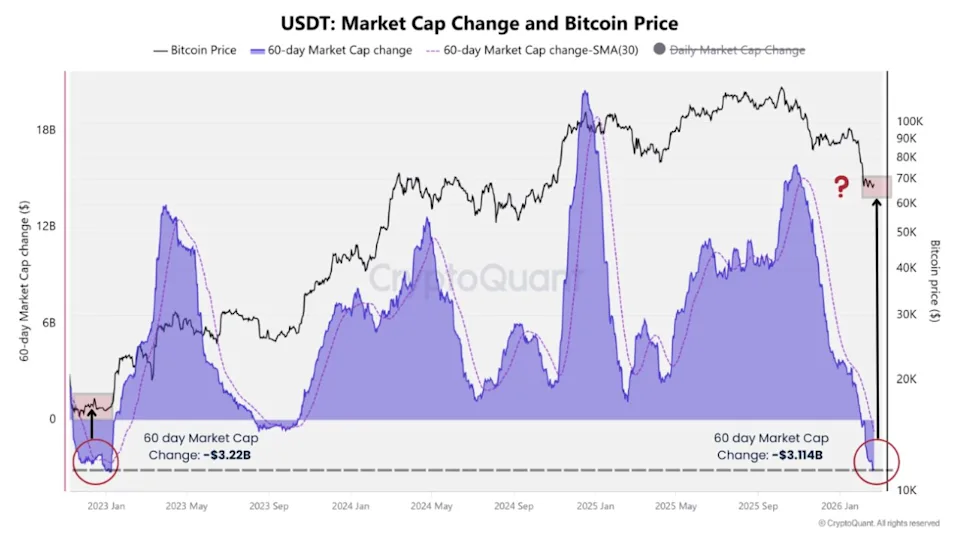
Data Source:CryptoQuant
When the lifeblood of crypto trading begins to dry up, smart money pays close attention.
Stablecoins act as the dry powder for institutional and retail investors alike. Historically, massive expansions in USDT supply translate directly into buying pressure. Conversely, when that supply dynamic stalls or flips negative, the market starves. Data from CryptoQuant confirms this current reality, highlighting severe liquidity constraints that historically align with major market bottoms.
The capital flow is telling a distinct story. The reduction in available stablecoin liquidity forces assets like Bitcoin to struggle, driving the recent downward pressure that pushed the asset into the mid-$60,000 range. Institutions are not blindly deploying capital. They are waiting for the dust to settle.
Is the bottom already in? It is highly probable. The 2022-era signal suggests the market has exhausted its heavy sellers. However, recognizing a bottom is only half the equation.
The more critical takeaway from this data is the velocity of the expected recovery. The headline clearly warns that the rebound may be significantly slower. We are not looking at a sharp, immediate V-shaped recovery driven by rapid retail euphoria. Instead, the market is bracing for a methodical, slow-burn accumulation phase.
Without a fresh, massive injection of newly minted USDT to act as a catalyst, capital will have to rotate slowly from within the existing ecosystem. Investors positioning for the next leg up must adjust their time horizons, prioritizing patience over the expectation of immediate returns.
The content provided in this article is for informational and educational purposes only. It is not intended to be, and should not be construed as, financial, investment, legal, or tax advice. The views and opinions expressed herein are those of the author and the cited sources (e.g., Tom Lee, BitMine Immersion Technologies) and do not necessarily reflect the official policy or position of the publisher.