U.S. Crypto Regulation: Tokenization, the CLARITY Act, and Trump’s $1B DeFi Push

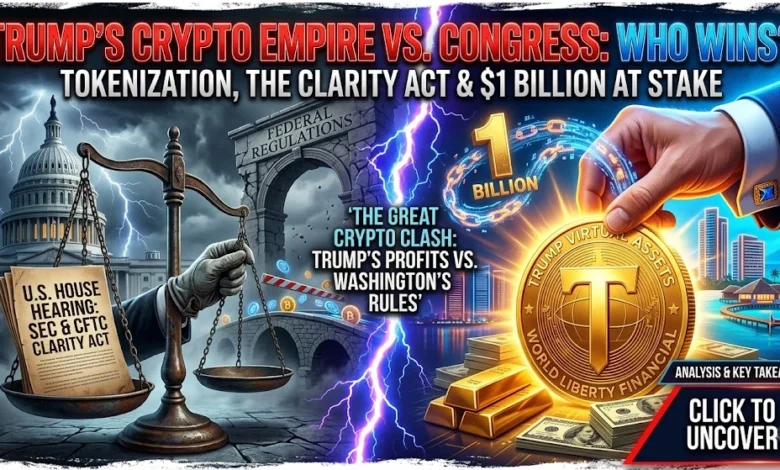
- A U.S. House of Representatives hearing convened this week to review the tokenization of real-world assets and securities.
- There is broad agreement among lawmakers that securities traded via tokens require the exact same regulatory treatment as regular trading.
- The CLARITY Act is the primary legislative vehicle being debated; it aims to determine whether specific tokenized assets fall under SEC jurisdiction (as digital securities) or CFTC jurisdiction (as digital commodities).
- Democratic Ranking Member Maxine Waters explicitly highlighted the Trump family’s financial involvement in the crypto sector during the hearing.
- Waters cited an estimated $1 billion in profits generated from ventures tied to the family, specifically pointing to World Liberty Financial (WLFI).
- Minority lawmakers flagged several systemic risks that must be resolved before advancing a permissive framework, including masked foreign ownership, Know Your Customer (KYC) compliance gaps, and the risks associated with anonymous wallets.
- World Liberty Financial recently partnered with Securitize and DarGlobal to tokenize loan revenue interests for the Trump International Hotel & Resort in the Maldives, targeting a 2030 completion.
- The SEC, under Chair Paul Atkins, recently proposed a “token taxonomy” framework that critics argue could exempt certain tokens (like governance and meme coins) from strict oversight.
The U.S. House of Representatives, the lower chamber of the United States Congress responsible for drafting federal legislation, held a pivotal hearing this week to review the tokenization of real-world assets. The core issue on the table is how to regulate traditional financial instruments like debt, equity, and real estate when they are issued and traded on public blockchain networks. While institutional capital waits on the sidelines to deploy billions into this emerging infrastructure, the political machinery in Washington is stalling. The bottleneck stems directly from the high-profile involvement of the executive branch in the very asset classes they are attempting to regulate.
The Regulatory Tug-of-War
Market makers have been begging for clear rules of engagement for years. According to recent coverage of the House hearing, there is finally “a broad agreement that securities traded via token need the same treatment as regular trading.” But agreeing on the premise is the easy part. Deciding who enforces those rules is where the capital flow stops.
The CLARITY Act’s Burden
The legislative vehicle attempting to resolve this gridlock is the CLARITY Act. This bill aims to permanently establish whether a tokenized asset operates as a digital security under the Securities and Exchange Commission (SEC) or a digital commodity overseen by the Commodity Futures Trading Commission (CFTC). For institutional asset managers, this single determination changes everything regarding registration requirements, investor protection liabilities, and compliance costs.
If an asset is classified as a security, the friction of trading it increases, but so does the legal certainty for institutional buyers. Currently, the SEC, under Chair Paul Atkins, is pushing a new “token taxonomy” to categorize these digital assets. Yet, passing the CLARITY Act requires 60 votes in the Senate. Securing that meaningful Democratic support is suddenly looking incredibly difficult.
The Trump Factor
The complication is not purely technical; it is intensely political. The Trump family’s aggressive move into decentralized finance through World Liberty Financial has transformed a dry market structure debate into a partisan flashpoint.
During the House hearing, Democratic Ranking Member Maxine Waters brought the administration’s crypto ties directly into the public record. Waters pointed to an estimated $1 billion in profits generated from ventures linked to the Trump family, making it impossible to separate the policy from the policymakers.
Masked Capital and KYC Gaps
Institutional money flow is highly sensitive to the concerns raised by minority lawmakers. Democrats flagged several structural risks that could delay any permissive regulatory framework. These include the dangers of anonymous wallets, severe gaps in Know Your Customer (KYC) compliance, and the risk of masked foreign ownership entering U.S. capital markets through tokenized platforms.
World Liberty Financial is actively testing these exact regulatory waters. The firm recently announced a partnership with BlackRock-backed Securitize and DarGlobal to tokenize loan revenue interests in the Trump International Hotel & Resort in the Maldives. This is a massive, real-time test case for bringing high-value, illiquid real estate onto public ledgers using private placement exemptions.
What This Means for Institutional Flow
For the market insiders managing traditional finance portfolios, the takeaway is clear: tokenization is an inevitable upgrade to market plumbing, but the immediate path is heavily politicized.
If the Trump administration’s personal crypto interests harden into a structural objection for Democrats, the CLARITY Act could stall indefinitely. Institutional investors are watching the ethics provisions of the current draft closely. Until those are resolved, the massive wave of Wall Street capital ready to tokenize real-world assets will likely remain constrained to highly controlled, private blockchain environments. The market wants public ledger liquidity, but Washington has to clear the muddy waters first.
The content provided in this article is for informational and educational purposes only. It is not intended to be, and should not be construed as, financial, investment, legal, or tax advice.