

South Korea’s ruling Democratic Party, the primary political faction shaping the nation’s current legislative agenda, is preparing a draft bill to absorb digital assets into traditional financial frameworks. According to a Wednesday report from the Seoul Economic Daily, the proposed Digital Asset Basic Act directly targets stablecoins and tokenized real-world assets.
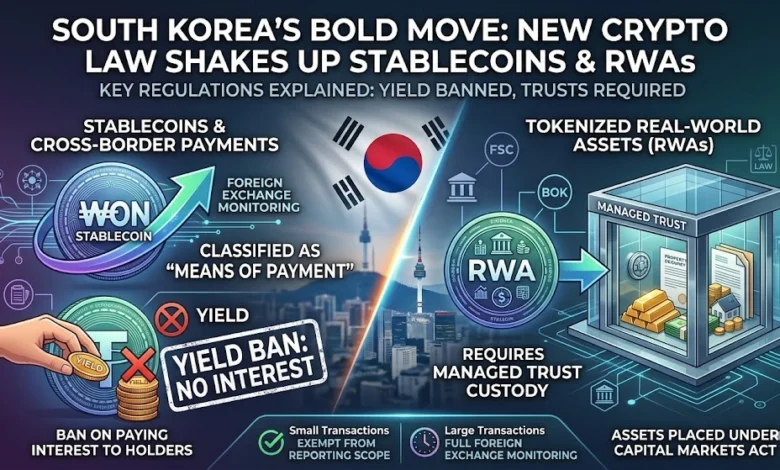
Under the integrated draft, stablecoins used for cross-border transactions will be legally recognized as a “means of payment.” This classification places them under the jurisdiction of the Foreign Exchange Transactions Act. Related businesses handling cross-border stablecoin flows will fall under immediate regulatory oversight without requiring a separate registration category.
The legislation mandates a strict boundary between payment utility and investment contracts. The draft explicitly bars issuers from paying interest to holders of value-stable digital assets. This prohibition applies regardless of how the incentive structure is labeled or marketed.
Regulatory requirements for tokenized real-world assets (RWAs) are also tightening. The bill mandates that RWA issuers place their underlying linked assets into managed trusts overseen by the Capital Markets Act. This requirement ties the issuance of blockchain-based tokens directly to existing, traditional custody frameworks.
The Financial Services Commission (FSC) has been tasked with establishing new technical standards. These standards will be aimed at ensuring basic interoperability across disparate digital asset networks operating within the country.
Notably absent from the current text are specific bank-related requirements for stablecoin issuers and ownership limits for cryptocurrency exchanges. Disagreements over these exact issuer requirements previously delayed the advancement of the Digital Asset Basic Act on December 31.
This legislative acceleration follows direct pressure from the central bank earlier this year. Korean won-denominated stablecoins could “complicate capital-flow management and foreign exchange stability,” Bank of Korea Governor Lee Chang-yong warned on January 27.
Recent reports provide further clarity on the scope of the draft Digital Asset Basic Act. The proposed legislation marks South Korea’s second distinct set of digital asset regulations.
The original regulatory framework was scheduled for a 2025 rollout. Multiple legislative delays pushed that timeline back, culminating in the current integrated draft.
The reporting burden for end-users will be bifurcated based on the size of the transfer. Small stablecoin transactions will be explicitly exempt from foreign exchange reporting requirements. Larger transactions will remain fully subject to the regulatory oversight mandated by the Foreign Exchange Transactions Act.
The draft’s prohibition on yield generation also contains specific parameters regarding user funds. The ban specifically targets “idle stablecoin balances.” Issuers and related businesses are prohibited from offering returns on funds held passively in digital wallets or exchange accounts.
The content provided in this article is for informational and educational purposes only. It is not intended to be, and should not be construed as, financial, investment, legal, or tax advice.