
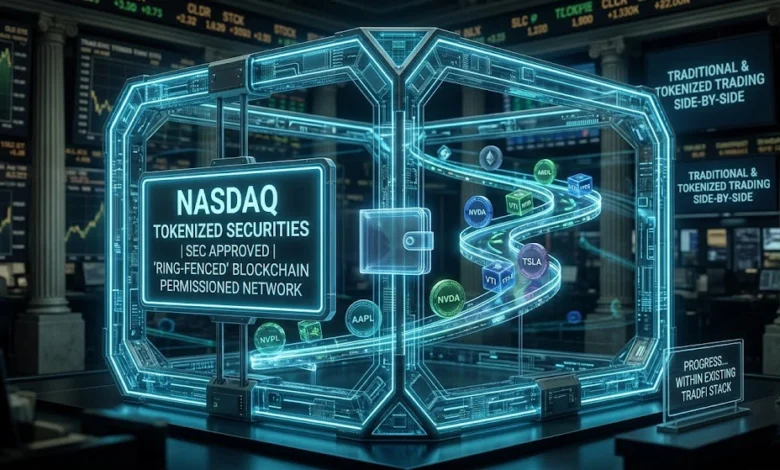
Nasdaq, the major U.S. stock exchange operator, just cleared a key regulatory hurdle. This week the SEC signed off on its plan to test tokenized versions of stocks and ETFs that run on blockchain while trading right next to their conventional counterparts.
On paper it looks like progress. Tokenized securities would sit in digital wallets. Blockchain would serve as an alternative record of ownership. Settlement could speed up dramatically. Around-the-clock trading becomes possible. Yet the details invite hard questions about timing and true intent.
Regulatory Green Light, Traditional Guardrails Intact
The approval centers on post-trade plumbing. DTCC, through its Depository Trust Company arm, keeps handling clearing and settlement. Everything stays permissioned. No wild decentralized experiments here just blockchain rails bolted onto the familiar TradFi stack.
Brian Steele, a DTCC executive, framed it positively: “safe, secure tokenization services to advance a more resilient, inclusive, cost-effective and efficient financial system.” Fair enough. But one wonders why regulators and incumbents are moving now, after years of watching crypto-native projects push the same ideas in other jurisdictions.
The Ring-Fencing Strategy
Maylea Ma, deputy general counsel at 1inch, cut straight to it: “Nasdaq is effectively ring-fencing the benefits of blockchain within the existing TradFi [traditional finance] stack.”
Investors might gain faster settlement or more flexible ownership features. Yet those gains occur only inside a closed system that still leans on intermediaries. Ma warned further: “If tokenized equities cannot connect to broader onchain liquidity and non-custodial execution, the efficiency gains will be incremental rather than transformational.”
That captures the downside. The $126 trillion global equity market and the $62 trillion U.S. slice could shift onto blockchain rails, as Val Gui of Kraken’s xStocks platform suggested. But the shift feels carefully controlled. Wall Street appears less interested in handing over power than in absorbing the technology on its own terms.
Mixed Signals from the Industry
Not everyone shares the caution. Gui called the move “a clear signal the $126 trillion equity market will be shifting onto blockchain rails,” adding that stock ownership becomes “24/7 and global.”
Ian De Bode, president of tokenization firm Ondo, viewed it as “encouraging” and an extension of the SEC’s earlier work with DTC. He noted progress toward 24/7 markets, even if permissioned.
Jesse Knutson, head of operations at Bitfinex Securities, highlighted what markets actually crave: “24/7 trading, fractionalization, real-time settlement and the ability to self-custody.” He conceded the U.S. move still lags “more progressive jurisdictions” such as Kazakhstan’s AIFC.
These contrasting takes reveal the tension. Optimists see incremental steps toward efficiency. Skeptics see a deliberate effort to limit disruption.
Why the Skepticism Matters
The core issue is control. By keeping tokenized securities tied to DTCC and traditional brokers, Nasdaq ensures blockchain serves the incumbents rather than replacing them. Global investors who have long lacked seamless access might benefit, as De Bode pointed out. Yet the same investors remain dependent on the same middlemen.
Timing adds to the doubt. Tokenization has thrived outside the U.S. for years. Now, as it gains mainstream traction, regulators hand the keys to the biggest player in the world’s dominant equity market. Coincidence? Or a calculated move to keep the $62 trillion U.S. market firmly in familiar hands?
The approval is real. The infrastructure is coming. But whether this delivers meaningful change or merely dresses up the old system in new code remains the open question Wall Street would rather not answer too loudly.
The content provided in this article is for informational and educational purposes only. It is not intended to be, and should not be construed as, financial, investment, legal, or tax advice.