
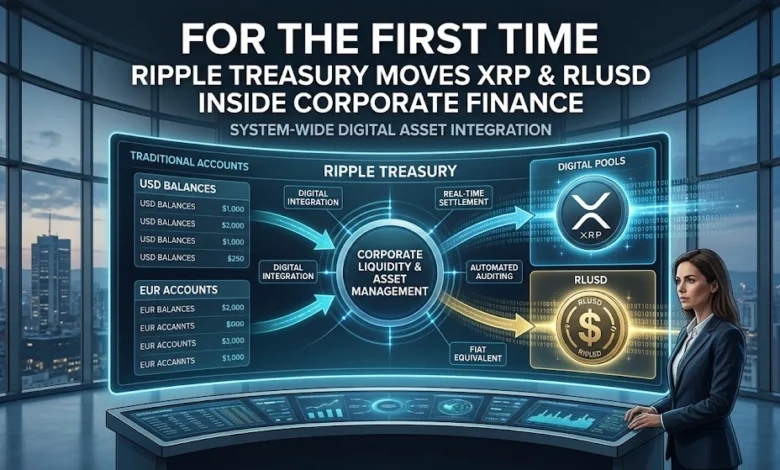
- Ripple Treasury has formally integrated XRP and its stablecoin, RLUSD, into its corporate finance operations.
- The integration follows Ripple’s $1 billion acquisition of enterprise software provider GTreasury in 2025, which processed $13 trillion in payment volume that year.
- Corporate finance teams can now execute stablecoin settlement and manage digital liquidity alongside traditional fiat without relying on separate third-party custody workflows.
Ripple Treasury Integrates XRP and RLUSD for Corporate Finance
Ripple, the enterprise blockchain and crypto payments firm, has executed a structural shift in its asset management and external product offerings. This week, the company launched “Digital Asset Accounts” and “Unified Treasury” within its Ripple Treasury platform.
This development marks the first time Ripple Treasury has positioned these digital assets directly inside an enterprise corporate finance framework. XRP serves as the firm’s primary digital asset, while RLUSD functions as its institutional-grade stablecoin.
By moving these assets into a native treasury system, the firm allows corporate finance teams to hold and manage digital liquidity alongside traditional cash. The update aggregates balances from bank accounts, on-chain wallets, and third-party custody providers into a single dashboard via an API layer.
Institutional Liquidity and Capital Flow
The structural shift aligns with measurable trends in institutional capital flow. Stablecoin transaction volume reached $33 trillion globally in 2025, representing a 72% increase from 2024.
Despite this volume, direct corporate allocation for enterprise use cases like payroll or cross-border settlement has remained limited by a lack of integrated tooling. Ripple’s rollout is engineered to capture this liquidity by routing it through its proprietary infrastructure.
The underlying technology builds directly on Ripple’s October 2025 acquisition of GTreasury for $1 billion. GTreasury processed $13 trillion in payments volume in 2025 for a client base spanning small businesses to Fortune 500 companies. Ripple is leveraging this existing institutional network to route digital asset flow through its systems.
Consolidating Corporate Workflows
The platform utilizes live market rates to update fiat values for XRP and RLUSD balances in real-time. It records transactions automatically, maintaining an audit trail that details the native notional amount, fiat equivalent, and market price at the time of each event.
Executives at the firm frame the product release as a direct response to shifting corporate balance sheet demands.
“Digital assets have arrived at the CFO’s desk, and the question has shifted from whether to engage to how to do so advantageously without disrupting existing operations,” Renaat Ver Eecke, Senior Vice President at Ripple Treasury, told reporters.
“Ripple Treasury gives the office of the CFO a trusted place to hold and manage digital and fiat assets – with no separate interface, no new workflows, and no need to navigate custody, wallets, or exchanges on their own,” Ver Eecke added.
Regulatory Context and Asset Custody
The product launch operates in tandem with Ripple’s recent regulatory positioning in the United States. On December 12, 2025, the Office of the Comptroller of the Currency (OCC) granted conditional approval to the Ripple National Trust Bank charter application.
This conditional approval provides Ripple with a framework to offer regulated custody and trust services. The treasury platform pairs enterprise software with this banking charter to serve corporate clients end-to-end.
Corporate treasury operations are strictly bound by compliance and audit requirements. Mark Johnson, Vice President of Global Product at Ripple Treasury, detailed the structural intent behind the platform’s engineering.
“The design principle behind both capabilities is that digital assets should behave exactly like cash within the platform,” Johnson said. “There is no separate digital asset workflow.”
Ripple noted that geographic availability depends heavily on jurisdiction-specific regulatory approvals. The firm has not disclosed specific transaction volumes handled by the new features since concluding its beta rollout.
The content provided in this article is for informational and educational purposes only. It is not intended to be, and should not be construed as, financial, investment, legal, or tax advice.