
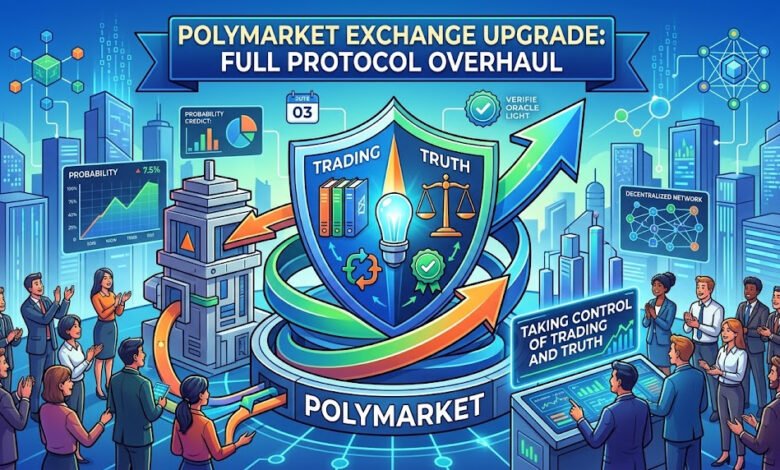
Polymarket, the decentralized prediction market platform, announced a comprehensive exchange upgrade on April 6, 2026. The protocol is altering its backend architecture to bring its core operations in-house.
The overhaul shifts the platform away from its previous reliance on external execution protocols and third-party data providers. The upgrade is specifically designed to allow Polymarket to “take control of its own trading and truth,” according to the initial report.
Trading Infrastructure Consolidation
Decentralized prediction markets typically function using a combination of off-chain order books and on-chain settlement. The announced upgrade targets the primary trading engine. By internalizing the trading infrastructure, the protocol establishes direct oversight of order matching, latency, and liquidity routing.
Managing the trading stack internally reduces Polymarket’s dependency on external network conditions and third-party decentralized exchange components. This protocol-level adjustment aims to optimize the execution environment for users trading binary outcome shares.
Internalizing Market ‘Truth’
The secondary component of the upgrade addresses how markets settle. Prediction platforms require data oracles to verify real-world events and trigger payouts. Polymarket’s decision to control its own “truth” indicates a strategic pivot away from external decentralized oracles.
Operating an internal resolution system necessitates a proprietary dispute framework. The protocol will process the verification of event outcomes directly, housing the settlement logic within its own upgraded parameters rather than querying outside networks.
This structural shift alters the fundamental risk model of the protocol. Controlling both trade execution and oracle data consolidates the operational flow, transferring the responsibility for data accuracy and dispute resolution entirely to Polymarket’s internal architecture.
The content provided in this article is for informational and educational purposes only. It is not intended to be, and should not be construed as, financial, investment, legal, or tax advice.