
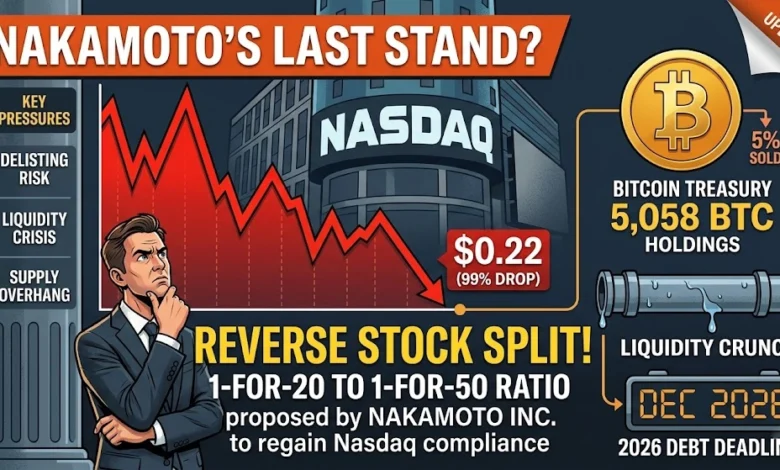
- Nakamoto Inc. is seeking shareholder approval for a reverse stock split between 1-for-20 and 1-for-50 to satisfy Nasdaq’s $1 minimum bid price requirement.
- The firm recently liquidated 5% of its Bitcoin reserves to fund operations, retaining 5,058 BTC amid growing liquidity constraints.
- A recent SEC filing registered over 400 million shares for resale, creating significant market overhang as the stock trades near $0.22.
Nakamoto Pushes Reverse Split to Defend Nasdaq Listing
Nakamoto Inc., the Nasdaq-listed Bitcoin treasury firm founded by David Bailey in May 2025, is seeking shareholder approval for a reverse stock split. The board aims to consolidate its 690 million outstanding shares at a ratio between 1-for-20 and 1-for-50 to artificially raise its per-share price.
The primary objective is to meet Nasdaq’s listing standards. The exchange previously issued a noncompliance notice to the firm, establishing a June 8, 2026, deadline to maintain a minimum $1 bid price for 10 consecutive business days.
Nakamoto’s equity has depreciated by approximately 99% from its 2025 peak, currently trading at $0.22. Shareholders will vote on the proposed consolidation at a virtual special meeting on May 8, 2026.
Liquidity Pressures and Bitcoin Sales
As Nakamoto attempts to restructure its equity, the firm is managing distinct liquidity challenges. The company recently liquidated about 5% of its Bitcoin holdings to fund internal operations.
The sale reduced its corporate treasury to 5,058 BTC. Market analysts point out that these capital requirements coincide with the firm’s debt obligations, specifically a $210 million Bitcoin-backed loan from Kraken that matures in December 2026.
According to the company’s preliminary proxy filing, the board seeks discretionary flexibility to select the exact ratio and timing within one year of approval. The filing explicitly notes the goal is to “combine outstanding shares of our Common Stock into a lesser number of outstanding shares” to mitigate delisting risks.
Supply Overhang and Capital Programs
Beyond the reverse split, Nakamoto has structured multiple avenues to issue and register new equity. The company recently filed a Form S-3 to register more than 400 million shares for potential resale by existing investors.
While this registration does not generate new capital for Nakamoto, it introduces a substantial supply overhang to the secondary market. If early investors exit, the volume could suppress the stock’s post-split price.
The firm also maintains direct capital acquisition vehicles. Nakamoto has a shelf registration permitting up to $7 billion in future securities issuance. A separate $5 billion at-the-market program allows the company to sell newly issued shares directly to the public over time.
The content provided in this article is for informational and educational purposes only. It is not intended to be, and should not be construed as, financial, investment, legal, or tax advice.