
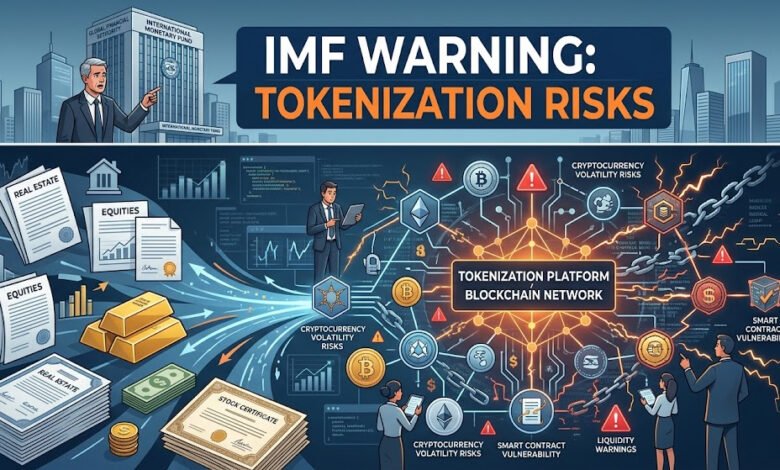
- The International Monetary Fund (IMF) has issued a formal warning regarding the integration of tokenized assets.
- The agency asserts that tokenization could transfer vulnerabilities native to the cryptocurrency sector into traditional global financial markets.
- A recent update to the report explicitly identifies automated markets and smart contracts as factors that could amplify financial volatility.
IMF Flags Tokenization as Vector for Contagion in Global Markets
The International Monetary Fund (IMF), the global financial agency responsible for monitoring macroeconomic stability, has issued a warning regarding the accelerating trend of asset tokenization. In a notice published on April 6, 2026, the organization stated that the tokenization process could introduce distinct cryptocurrency risks into standard global financial markets.
Tokenization involves creating digital representations of traditional financial instruments, such as equities, bonds, or real estate, on distributed ledger technology. Institutional entities have explored this infrastructure to reduce settlement times and operational costs.
The IMF’s warning centers on the underlying infrastructure of these digital assets. When traditional assets are recorded on blockchain networks, they become exposed to the structural vulnerabilities of those networks.
Infrastructure Vulnerabilities and Market Stability
Cryptocurrency networks carry specific operational risks. The IMF report specifically cautioned that tokenization could amplify market volatility through the use of automated markets and smart contracts.
These programmatic agreements execute automatically based on predefined conditions. In high-stress market scenarios, cascading liquidations or algorithmic failures within these smart contracts could accelerate price swings without the standard human oversight or delay mechanisms present in traditional finance.
If global financial markets begin relying on these networks for the settlement and clearing of tokenized real-world assets, a localized technical failure on a blockchain could trigger broader systemic disruptions. The IMF’s position highlights the difficulty of isolating traditional financial collateral from the technical execution risks of decentralized ledgers.
Regulators worldwide have historically prioritized the separation of digital asset volatility from the traditional banking sector. This recent communication from the IMF reinforces the stance that the technological rails themselves, not just the speculative assets they typically carry, demand stringent regulatory oversight before achieving macroeconomic integration.
The content provided in this article is for informational and educational purposes only. It is not intended to be, and should not be construed as, financial, investment, legal, or tax advice.