
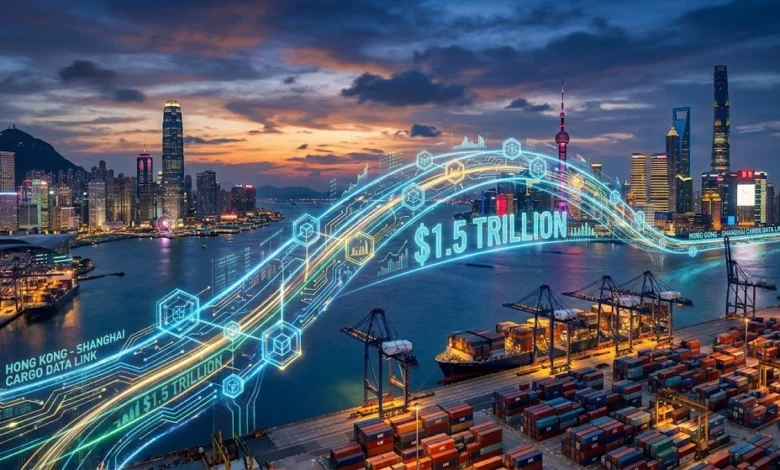
Hong Kong and Shanghai trade authorities have inked a deal to build blockchain infrastructure for cross-border cargo data. The initiative targets a massive $1.5 trillion annual cargo finance market plagued by expensive paper-based delays and fraud. By integrating with the HKMA’s Project Ensemble, the platform provides international capital a compliant gateway to Chinese trade data.
Bridging the Capital Divide
The Hong Kong Monetary Authority (HKMA) the city’s de facto central bank and financial regulator is making a highly calculated play for institutional trade volume. Announced Monday afternoon in Hong Kong, the HKMA, alongside the Shanghai Data Bureau and the National Technology Innovation Center for Blockchain, formalized a memorandum of understanding to construct a shared digital platform.
This isn’t just an administrative update. By building cross-border blockchain rails to link trade data, electronic bills of lading, and financing systems, Hong Kong is aggressively reinforcing its position as the primary financial bridge between mainland China and global capital markets.
Real-World Plumbing for a $1.5 Trillion Market
For years, institutional investors have watched blockchain technology circle the fringes of the real economy. Now, the capital flow is being directed at a specific, highly lucrative target: $1.5 trillion in annual cargo finance.
This is an industry heavily burdened by friction. The traditional system relies on outdated mechanics. As noted in the announcement, authorities are directly targeting operational bottlenecks “where paper documents, fragmented data, and manual verification continue to slow credit decisions.” These archaic processes cost the industry dearly in both fraud and simple administrative delays.
Interestingly, the underlying architecture points to a broader institutional shift. The agreement highlights a “growing adoption of bitcoin in real-world plumbing,” a clear indicator that major trade hubs are looking beyond speculative trading and tokenized green bonds. They want robust, immutable ledgers handling actual supply chain data.
The Mechanics of the Trade
How does the money actually flow through this new setup? The parties intend to study the creation of this cross-border platform under the HKMA’s existing Project Ensemble framework.
It is a multi-layered integration. The initiative will utilize electronic bills of lading and blockchain-based documentation to streamline the issuance of trade finance. Crucially, it will connect with Hong Kong’s Commercial Data Interchange and CargoX, enabling highly secure data sharing.
For international banks and institutional lenders, this is the real prize. Plugging mainland cargo data directly into Hong Kong’s international-facing infrastructure offers foreign capital a compliant, verifiable gateway into Chinese trade data. Credit decisions can be executed faster, with significantly lower risk profiles.
Ultimately, regulators are positioning this beyond a mere proof-of-concept. They are moving to “turn blockchain from a pilot project into core cross-border financial infrastructure.” If the execution matches the ambition, Hong Kong will embed itself permanently into mainland supply chains, securing its institutional relevance for decades to come.