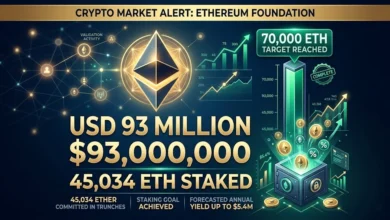

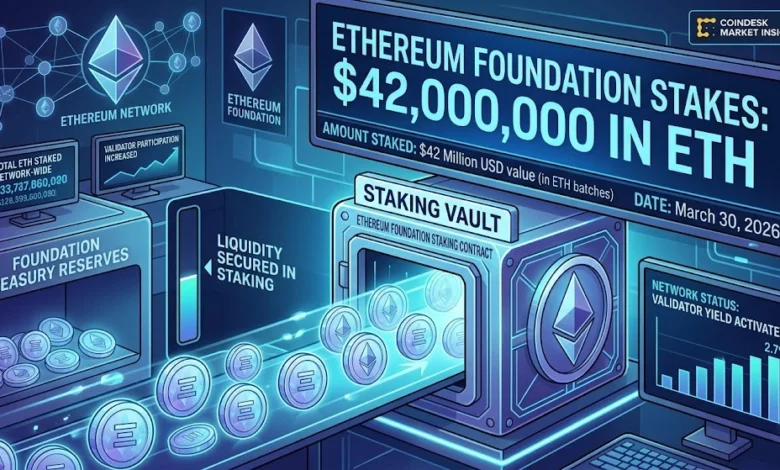
The Ethereum Foundation, the non-profit organization responsible for funding and supporting the development of the Ethereum blockchain, has expanded its active network participation. On March 30, 2026, the organization staked an additional $42 million worth of its Ether treasury.
Staking on the Ethereum network requires locking up capital to secure the blockchain and validate transactions in exchange for a baseline yield. By moving these assets into a staking contract, the Foundation has effectively removed $42 million of liquidity from immediate circulation.
Wallet movements by the Ethereum Foundation are heavily tracked by on-chain analysts. Historically, large transfers from the Foundation’s public addresses to centralized cryptocurrency exchanges are interpreted as operational liquidation events. Conversely, routing funds to staking contracts signals a long-term hold strategy and active deployment of idle capital.
Yield Metrics and Broader Treasury Strategy
Blockchain intelligence firm Arkham reported that the Monday deposits were executed in uniform batches of approximately 2,047 ETH. These transfers are part of a broader treasury directive initiated in February, wherein the Foundation outlined an intent to stake up to 70,000 ETH. The stated objective of this initiative is to convert long-held reserves into a consistent income stream to fund research, grants, and ecosystem development.
Based on the CoinDesk Composite Ether Staking Rate (CESR), the newly staked capital is projected to generate an annualized yield of 2.7%. This figure represents a contraction from the 3.4% yield observed earlier in the year, reflecting increased total validator participation across the broader network.
Despite removing this $42 million from immediate market liquidity, the organization maintains substantial reserves. Current on-chain data indicates the Ethereum Foundation treasury holds an additional 147,400 ETH, valued at approximately $303 million. This ensures significant capital remains available for short-term operational requirements.
The content provided in this article is for informational and educational purposes only. It is not intended to be, and should not be construed as, financial, investment, legal, or tax advice.