
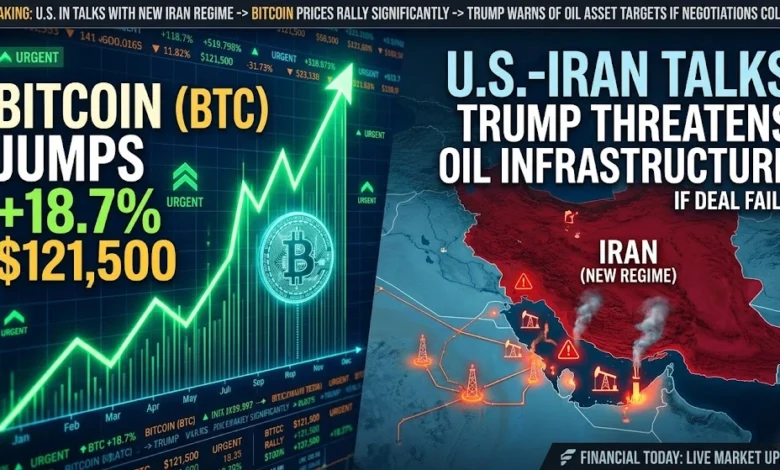
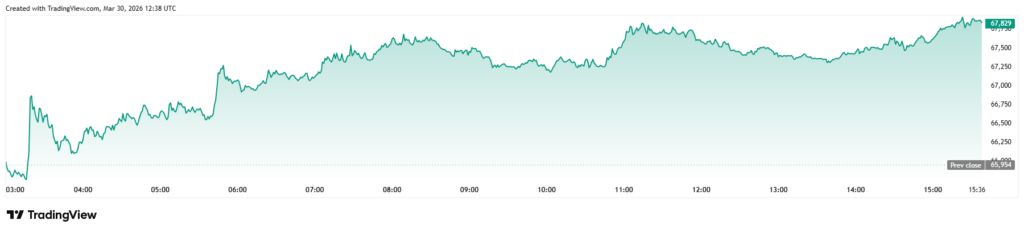
Bitcoin, the largest digital asset by market capitalization, experienced sudden upward price action on March 30, 2026 ($67.800). The price increase aligned directly with developing geopolitical events in the Middle East and subsequent statements from the U.S. government.
President Trump stated that the United States is currently “in talks with [the] new regime in Iran.” The administration also outlined severe consequences regarding the outcome of these diplomatic discussions.
If the negotiations break down, the U.S. “threatens oil infrastructure if [the] deal fails.” This ultimatum immediately introduced severe disruption risks to global energy supply chains.
Energy Markets and Crypto Liquidity
The threat to Middle Eastern oil infrastructure routinely drives volatility in traditional commodities. Market data indicates that capital quickly moved into alternative assets, driving the Bitcoin jump as traders priced in the potential for energy market destabilization.
Bitcoin mining relies heavily on global energy pricing. Any kinetic action against major oil infrastructure alters the underlying cost of energy worldwide. Institutional traders react to these macro-economic shifts by adjusting risk parity across portfolios, which includes reallocating funds into digital assets during periods of fiat or commodity uncertainty.
The immediate market response demonstrates how sensitive algorithmic trading and institutional capital remain to international diplomacy. Traders are currently holding positions based on the binary outcome of the U.S. negotiations with the new Iranian government.
Cross-Market Repricing and Futures Activity
The geopolitical update triggered an immediate, large-scale cross-market repricing. Market data shows that roughly $1.5 billion in S&P 500 futures contracts were executed shortly before the public confirmation of the negotiations.
Within minutes of the administration’s statements, the S&P 500 added approximately $2 trillion in market value. Traders simultaneously adjusted energy positions, selling crude oil contracts to remove the risk premium associated with prior Middle Eastern supply disruptions.
Macro Context: Leadership Transition and IEA Warnings
The current diplomatic talks follow the March 8, 2026, appointment of Mojtaba Khamenei as Iran’s Supreme Leader. This domestic leadership transition occurred alongside sustained regional military escalations and restricted trade routes.
The International Energy Agency (IEA) recently reported that 40 major energy assets across the Middle East have already sustained severe damage during the ongoing conflict. In response to the widening scope of the instability, G7 foreign ministers issued a joint statement confirming their operational readiness to protect global energy supplies and maritime shipping lanes.
Liquidation Data and Asset Decoupling
Prior to the upward price jump, Bitcoin recorded a local low of $64,785. This brief period of downward volatility liquidated approximately 86,000 leveraged derivative traders across major exchanges.
The subsequent crypto market rally highlights a measurable breakdown in the historical correlation between digital assets and traditional equities. Institutional analysis indicates that Bitcoin is currently being utilized by funds as a non-correlated hedge against both regional energy infrastructure instability and shifting global supply chains.
The content provided in this article is for informational and educational purposes only. It is not intended to be, and should not be construed as, financial, investment, legal, or tax advice.