Bitcoin Cryptography Faces Accelerated Quantum Threat, Nobel Physicist Warns

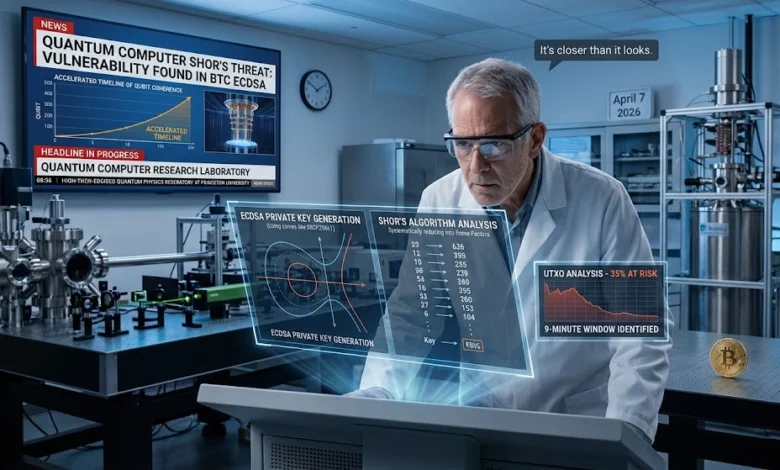
Nobel Physicist Warns of Accelerated Quantum Threat to Bitcoin Cryptography
Bitcoin, the decentralized network utilizing a proof-of-work consensus mechanism to secure its ledger, is facing a revised security timeline. According to a report published April 7, a Nobel physicist warned that the theoretical quantum computing threat to the network is credible and advancing faster than previously modeled.
The core of the issue centers on Bitcoin’s cryptographic infrastructure. The network relies on the Elliptic Curve Digital Signature Algorithm (ECDSA) for generating public and private key pairs. While the SHA-256 algorithm used for block hashing remains highly resistant to near-term quantum operations, ECDSA is vulnerable to Shor’s algorithm.
“The quantum threat is real and closer than it looks,” the physicist(John Martinis) noted in the report.
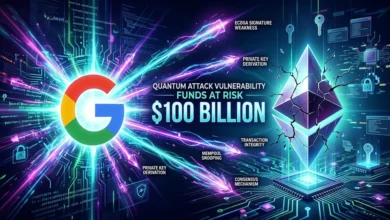
If a sufficiently powerful quantum computer with logical, error-corrected qubits becomes operational, it could calculate private keys from public keys exposed on the blockchain. This would allow an attacker to sign transactions and spend funds from any address where the public key is known.
Protocol Upgrade Implications
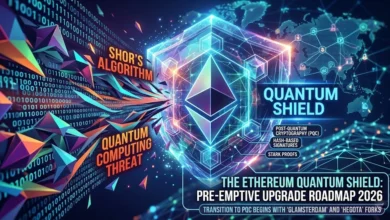
This accelerated timeline forces Bitcoin Core developers to evaluate migration paths to post-quantum cryptography (PQC) sooner than expected. Transitioning the network to new signature schemes, such as lattice-based cryptography, requires significant architectural changes.
Implementing these changes necessitates a hard fork. This process requires overwhelming consensus among node operators and mining pools to adopt the new software rules. Upgrading the signature scheme will also increase transaction sizes, impacting block space and transaction fees.
Network engineers are currently researching soft-fork and hard-fork combinations to secure unspent transaction outputs (UTXOs) before quantum hardware reaches the necessary qubit threshold to break ECDSA.
The Nine-Minute Attack Window
The renewed urgency follows a March 30 research paper published by Google Quantum AI. The researchers modeled an attack scenario demonstrating that a sufficiently scaled quantum computer could derive a private key from an exposed public key in approximately nine minutes using Shor’s algorithm.
Because Bitcoin’s average block confirmation time is ten minutes, an attacker would possess a statistical window to intercept a broadcasted transaction, calculate the private key, and redirect the funds before the legitimate transaction settles on the ledger.
According to 2025 Nobel laureate John Martinis, who has publicly urged the industry to transition cryptographic systems before the technology matures, protocol developers have a finite timeframe to execute these upgrades to avoid systemic compromise.
Vulnerable Supply and Historical UTXOs
Current data models indicate that approximately 35% of the total circulating Bitcoin supply resides in theoretically vulnerable addresses. This supply primarily consists of early network blocks—including those mined by Satoshi Nakamoto—and reused addresses where the public key is already permanently visible on the blockchain.
These exposed public keys bypass the nine-minute transaction window entirely. They represent a static target for developers operating quantum hardware, allowing them to systematically derive the private keys and claim the unspent transaction outputs (UTXOs) without intercepting live network traffic.
The Block Space Trade-off
Implementing Post-Quantum Cryptography (PQC) introduces severe engineering friction at the protocol level. Lattice-based signature schemes, a primary candidate for replacing ECDSA, produce signatures up to 80 times larger than current formats.
Under these cryptographic parameters, a standard Bitcoin block that currently processes roughly 7,600 transactions would be reduced to processing fewer than 400. This reduction in transaction density would force a fundamental restructuring of Bitcoin’s fee market and drastically increase the cost of operating a full node.
The content provided in this article is for informational and educational purposes only. It is not intended to be, and should not be construed as, financial, investment, legal, or tax advice.