
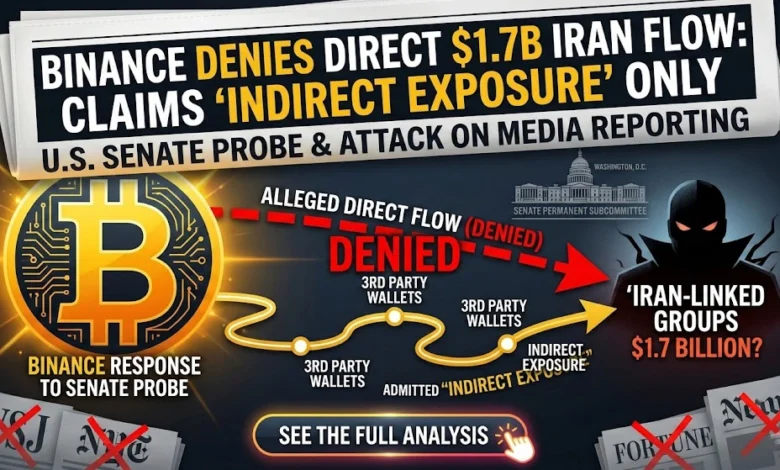
Binance firmly denies processing $1.7 billion in direct crypto transactions to Iran-linked entities, citing only “indirect exposure” in a March 6 letter to the U.S. Senate. The exchange aggressively pushed back against major media outlets, labeling their investigative reports on the matter “defamatory” and “demonstrably false.”
Regulatory scrutiny has a way of parsing words down to the syllable. When $1.7 billion is alleged to have slipped through the cracks into sanctioned territories, the difference between “direct” and “indirect” exposure becomes the entire defense strategy.
Binance, the largest crypto exchange, is currently threading this exact needle. In a March 6 letter addressed to Sen. Richard Blumenthal’s Permanent Subcommittee on Investigations, the exchange formally responded to a deepening U.S. Senate probe regarding alleged funds moving to Iran-linked organizations, including Yemen’s Houthi militants.
The Fine Line of “Indirect Exposure”
The allegations are heavy. Binance’s response, however, hinges tightly on technicalities and distance. The exchange claims its internal review found absolutely no evidence that platform accounts transacted directly with Iranian entities.
Instead, they concede to finding only “indirect exposure” to wallets that may have carried Iranian links.
This defense raises immediate questions about the efficacy of blockchain surveillance at scale. If an entity is only one or two hops away from a sanctioned wallet, does the lack of a “direct” link absolve the platform? Binance seems to think so, though they did take action after the fact.
Offboarding Hexa Whale and Blessed Trust
The timeline of Binance’s internal review is equally telling. The exchange noted that its investigation did not start in a vacuum; it began after law enforcement knocked on their door last April, seeking information about transactions tied to potential terrorist financing.
Following this prompt from authorities, Binance identified two specific entities interacting with the flagged external wallets: Hexa Whale and Blessed Trust. The exchange removed Hexa Whale from the platform the following August and finally offboarded Blessed Trust in January. Why the months-long gap between the April law enforcement inquiry and the ultimate account closures? That lingering question remains unaddressed in the provided response.
Rather than simply defending its compliance infrastructure, Binance took the offensive against the press. The exchange aggressively targeted the media coverage that catalyzed the Senate probe in the first place.
Reporting from heavyweights like the New York Times, the Wall Street Journal, and Fortune was openly dismissed. Binance called the coverage “demonstrably false” and “defamatory in several material respects.”
Furthermore, the exchange vehemently denied reports that internal compliance investigators were pushed out for raising red flags about these exact issues. According to Binance, most staff departures were entirely voluntary. Only one employee was explicitly terminated, and that was allegedly for violating company policy regarding the disclosure of internal user information.
Binance’s legal team provided user records and transaction histories to investigators, emphasizing their cooperative stance with authorities.
“When there is credible risk information, Binance investigates, mitigates, offboards accounts, and reports to appropriate authorities,” the letter stated. The exchange further defended its internal controls, claiming, “Binance has a rigorous compliance program that is consistently growing stronger.”
Yet, skepticism naturally persists. When a platform processes billions of dollars, a compliance program that is merely “growing stronger” might just be playing an endless game of catch-up with bad actors. As the Senate subcommittee reviews the March 6 letter, the real test will be whether lawmakers accept the defense of indirect exposure, or if they decide that in the realm of global sanctions, any exposure is simply too much.